Explainer
The Dollar, Decoded: the DXY, Rate Differentials and the Dollar Smile
A currency's strength is a relative price, not a verdict on a single economy. The dollar rises when the United States offers a better combination of yield, growth and safety than the alternatives, and falls when the rest of the world catches up. That is why the desk calls the dollar the relative winner: it does not need to be attractive in the absolute, only less unattractive than what it trades against. This explainer covers the index everyone quotes, the forces that actually move it and the framework the desk uses to read it.
What the DXY is, and what it is not
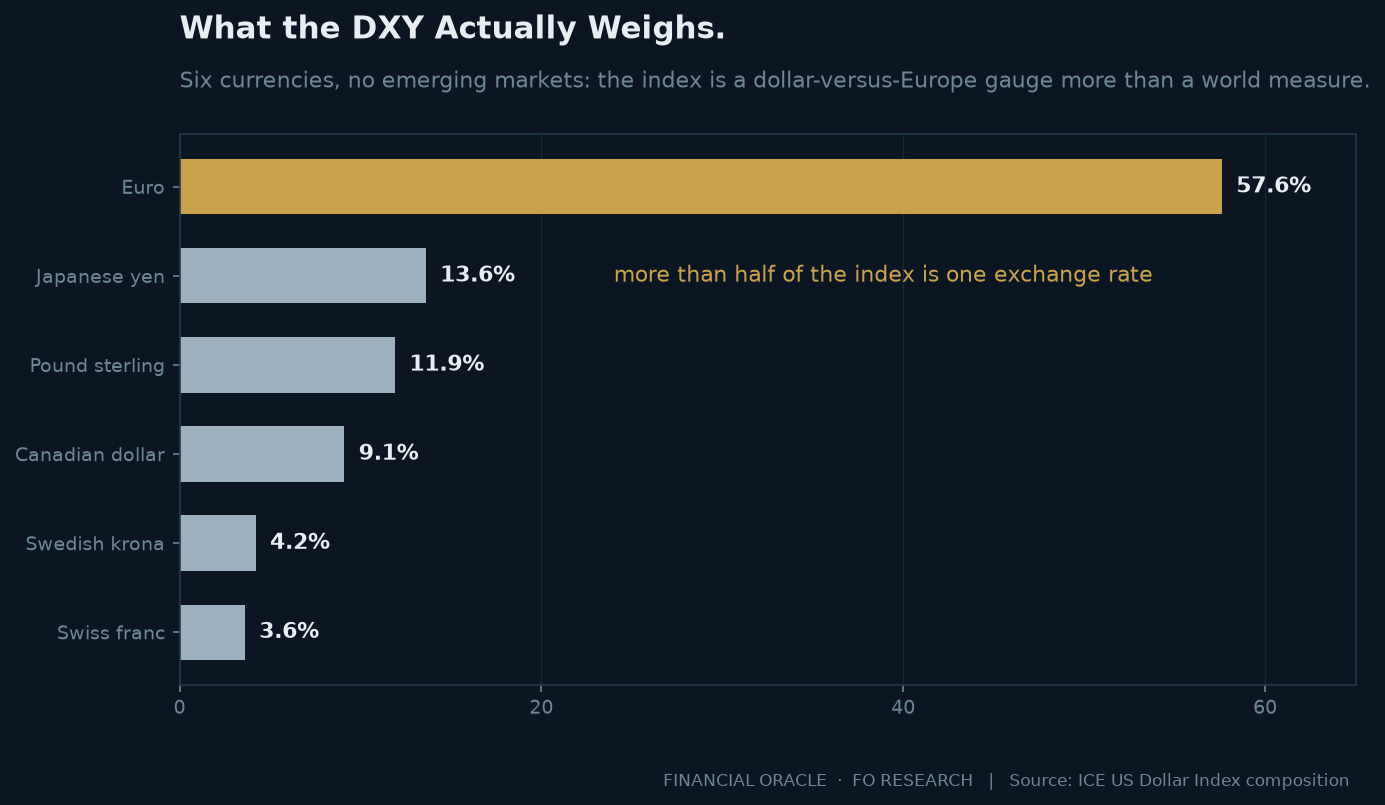
The US Dollar Index, the DXY, is a weighted geometric average of the dollar against six currencies. The weights have been broadly fixed for decades: the euro at 57.6%, the yen at 13.6%, sterling at 11.9%, the Canadian dollar at 9.1%, the Swedish krona at 4.2% and the Swiss franc at 3.6%.
Read those weights again. More than half of the index is a single exchange rate: euro-dollar. There are no emerging-market currencies in it at all, no renminbi, no peso, no rupee, despite their weight in actual US trade. The DXY is therefore best understood as a dollar-versus-Europe gauge with a Pacific accent, not a measure of the dollar against the world. It remains the market's shorthand because it has a long, continuous history and a deep, liquid derivatives market, but a desk that wants the true broad dollar looks at trade-weighted measures alongside it. When the DXY and the broad dollar diverge, the divergence itself is information.
What actually moves a currency
Four forces do most of the work, and they compound rather than compete.
Rate differentials. Capital moves toward return. When US yields sit above comparable foreign yields, holding dollars pays, and the flow supports the currency. What matters is the differential and its expected path, not the level of US rates alone: a Fed cutting more slowly than the ECB can be dollar-supportive even in an easing cycle. This is the same composition discipline the desk applies to long yields: the headline moves, the components decide.
Growth differentials. Capital also moves toward opportunity. An economy outgrowing its peers tends to attract investment flows into its assets, often creating additional demand for the currency, although hedging can offset part of that effect. Sustained US outperformance, in productivity or simply in earnings, is a structural dollar bid.
Flows and the balance of payments. Trade deficits supply dollars to the world; investment inflows demand them back. The dollar's reserve role sits here too: central banks and global borrowers need dollars as the world's funding and invoicing currency, which builds a standing structural demand beneath the cyclical story. When reserve managers diversify away, as they have into gold, that is the same force running in reverse, a thread the desk pulls in Gold vs Real Yields.
Safety. In stress, the world runs to the deepest, most liquid market there is: US Treasuries. The dollar often strengthens during global stress, even when the shock originates in the United States, because Treasury-market depth, dollar funding needs and the demand for liquidity can outweigh concerns about the source of the shock.
The dollar smile
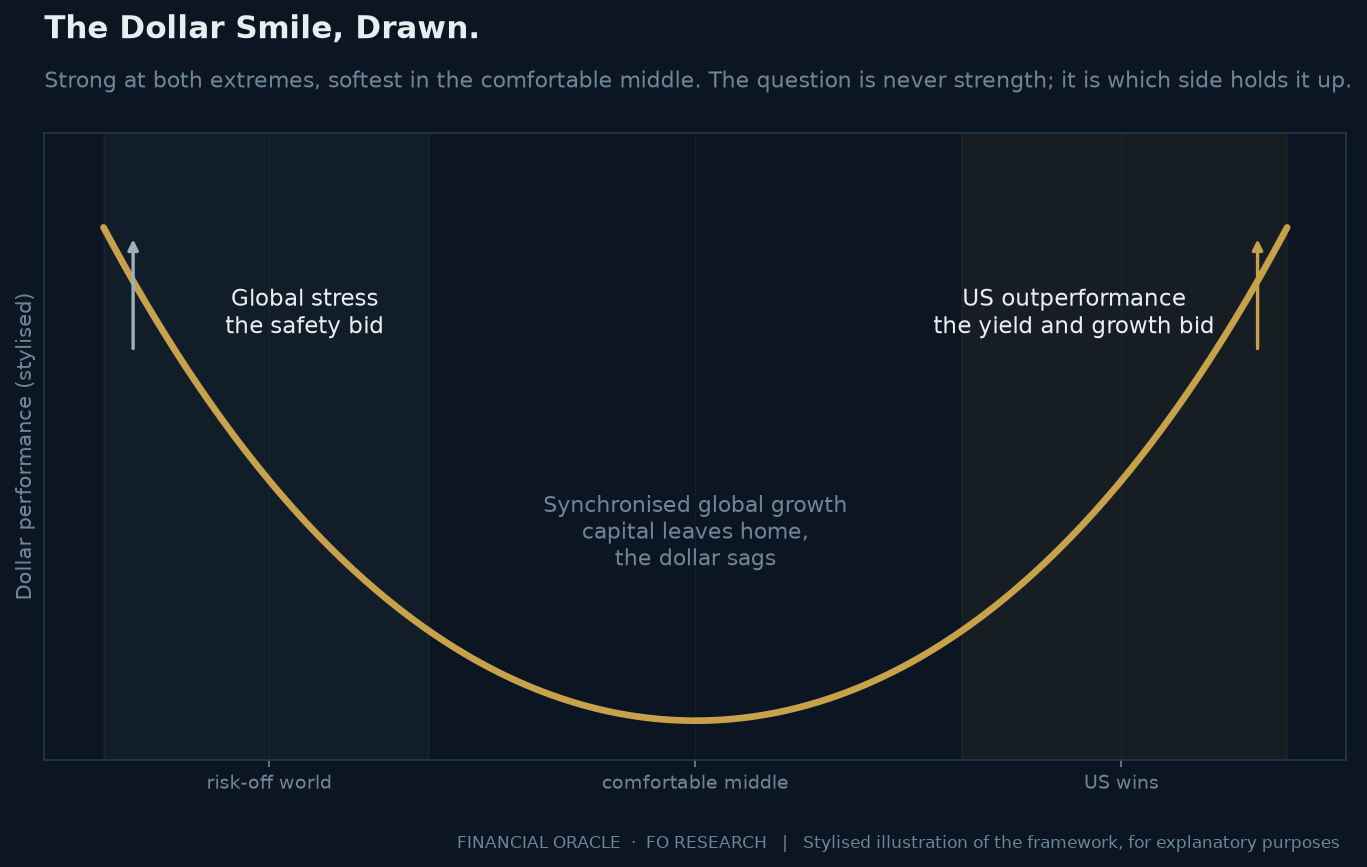
Those four forces produce a pattern that practitioners have long described as a smile. On the left side of the smile, the world is in trouble: risk is off, and the safety bid lifts the dollar. On the right side, the United States is winning: growth and yields outpace the rest of the world, and the return bid lifts the dollar. The dollar sags in the middle, when global growth is synchronised and comfortable, risk appetite is broad and capital is happy to leave home in search of higher-beta returns elsewhere.
The smile is a framework, not a law. Its value is diagnostic: it forces the right question, which is never "is the dollar strong?" but "which side of the smile is holding it up?" A safety-bid dollar and a yield-bid dollar behave differently, fade differently and hedge differently. Misreading which regime you are in is the most common way to be right about the world and wrong about the currency.
The desk's read: the relative winner
The desk's standing framework for the current cycle sits on the right side of the smile: yield differentials, relative growth and policy divergence have kept the dollar the least unattractive major currency even through an easing cycle. That case was laid out in Why the U.S. Dollar Could Stay Stronger for Longer and extended through the desk's dated notes since, alongside the oil and rates legs of the same regime in Dollar Strength, Oil Inflation and Higher-for-Longer Rates. Those are dated calls, scored against the tape in the track record; this page is the machinery behind them.
The counterweight is structural: reserve diversification, gold accumulation and the slow build of non-dollar settlement are real forces running the other way. The desk's read is that they are measured in years, not quarters, and that de-dollarisation headlines routinely overstate their speed while understating their direction. Both things can be true. The dollar can be the relative winner of this cycle while its structural share of the global system erodes at the margin.
Frequently asked questions
What is the DXY and how is it calculated?
The DXY is the US Dollar Index: a weighted geometric average of the dollar against six currencies, dominated by the euro at 57.6%, with the yen, sterling, the Canadian dollar, the krona and the franc making up the rest. It contains no emerging-market currencies, so it measures the dollar against a narrow group of developed-market currencies, with a pronounced European bias, rather than against the world.
Why is the US dollar so strong?
Because strength is relative. The dollar is supported when US yields and growth outpace the alternatives and when global stress drives a safety bid into US assets. Several of those forces can act at once, and none requires the US economy to be flawless, only to offer a better combination of return and safety than its peers.
What is the dollar smile?
A practitioner framework in which the dollar strengthens at two extremes, global stress on one side and US outperformance on the other, and weakens in the middle, when global growth is synchronised and capital flows happily into riskier, higher-yielding markets elsewhere.
Do Fed rate cuts weaken the dollar?
Not automatically. Currencies price relative paths, so a Fed easing more slowly than other central banks can leave the dollar supported. What matters is the rate differential, the growth differential and which side of the smile is doing the work, not the direction of any single central bank in isolation.
Is de-dollarisation actually happening?
At the margin, yes: reserve managers have diversified, notably into gold, and some trade now settles outside the dollar. But the dollar remains the dominant funding, invoicing and reserve currency by a wide margin, and the desk's read is that the erosion is a slow structural trend, not a cliff. Direction and speed are different questions.
This explainer is part of the FO Research library. The desk publishes its market reads before the print, dates them, and scores them against the tape afterwards. We read the data. We call the paths.


The research is Premium. The record is public.
Every Brief and Analysis in full: the scenario maps with explicit invalidation, the cross-asset tactical reads, the desk-formatted PDFs, and a scorecard where every call is dated before the print and scored after it, misses included. Inspect the record before you pay for it.
Subscribe to Premium →Not ready? Get the teasers by email, free · New to the mechanics? Learn is open to everyone.