FO Research / Macro
Macro
research.
All FO Research reports filed under Macro.
57 reports filed under Macro
 What Is a Credit Spread? HY OAS Explained
 Twelve to Nothing. The Curve Went Further.
The committee raised rates on 16 September without a single dissent, deleted the energy language from its statement and put one more rise in the dots. The desk registered four tests on that decision and pre-committed in print to scoring them on the following Thursday's settle. It did not. This note scores them seven sessions late, says so in the first row of its own table, and then scores a level and a claim the desk had to defend and did not hold: a thirty-year range that broke on 24 September and has widened since, and a buyback queue the desk is retiring rather than arguing with. What survived is the mechanism, and it is the part worth reading. Measured from the close before the August inflation print, the ten-year is twenty-nine basis points higher and the market's own inflation forecast is six lower. The whole move is real, and then some.
 FO Analysis: The Tide Line.
On 18 August this desk wrote that late July's seven hawkish dissents across three central banks were the high-water mark of rate-rise pricing, and named the sequence that would make that mark a tide line: the shock returns, the August inflation print lands hot into the September decision and the rise comes back.
 The Issuer Offered Six. The Market Sold It.
The first enlarged buyback was disappointing before it ran. Treasury capped Thursday's ten to twenty year operation at $6bn, above the $4bn floor it had guided and below the $10bn some had come to expect, and the curve sold the number into a $100 barrel: the ten-year to its highest in nearly three years, the thirty-year into the upper half of the range the desk redrew in August, the two-year backing up toward the Fed's own week. On Thursday the desk got both hands on one tape, a $22bn thirty-year auction at 18:00 London and the operation itself an hour later. The read was written down before the prints and is scored on the settles below.
 Bear Steepener vs Bull Flattener: Curve Moves Explained
 FX Intervention and the Line at 160
 Payrolls Revisions and the Benchmark
 July Never Happened. September Re-Arms.
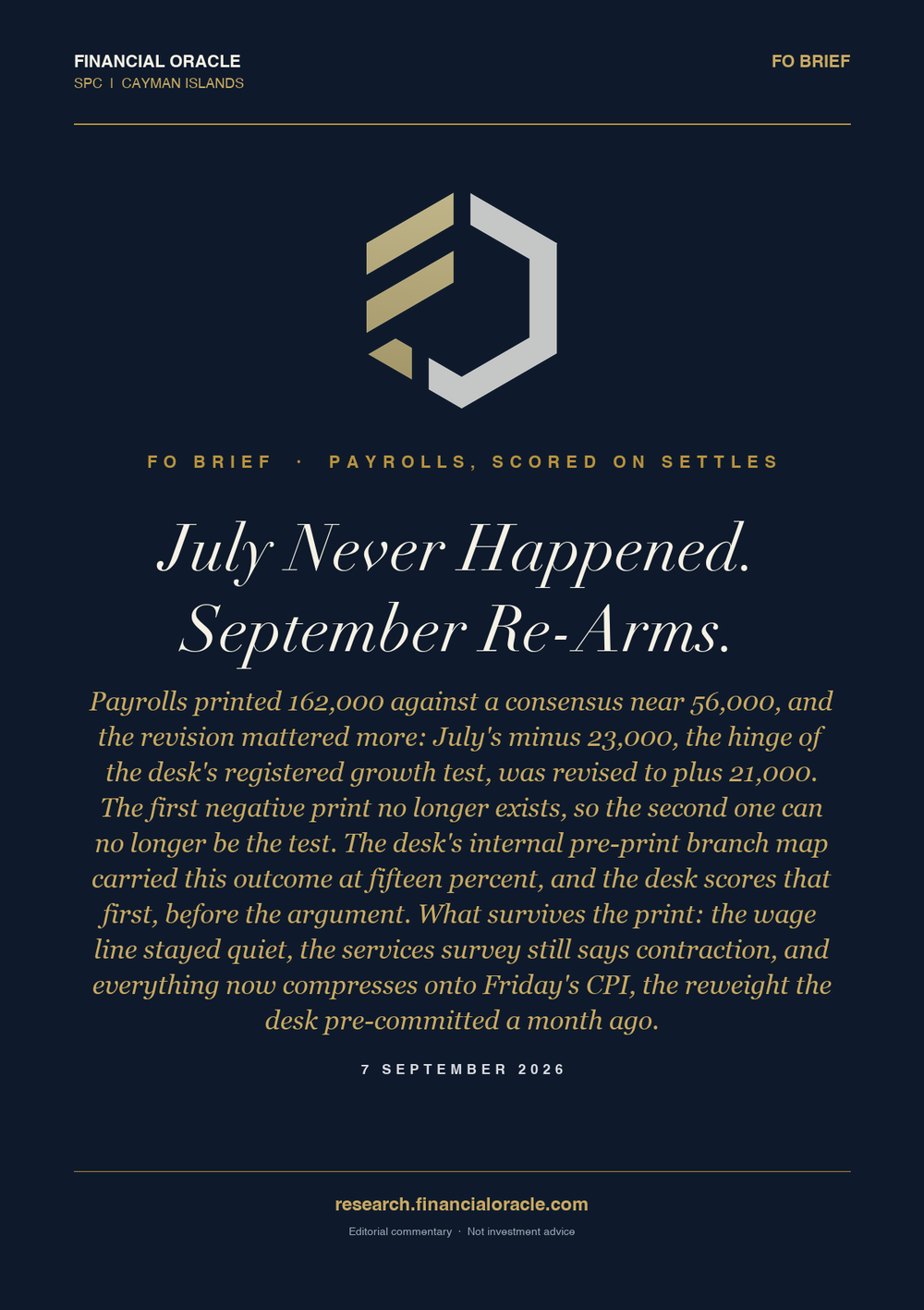
Payrolls printed 162,000 against a consensus near 56,000, and the revision mattered more: July's minus 23,000, the hinge of the desk's registered growth test, was revised to plus 21,000. The first negative print no longer exists, so the second one can no longer be the test. The desk's internal pre-print branch map carried this outcome at fifteen percent, and the desk scores that first, before the argument. What survives the print: the wage line stayed quiet, the services survey still says contraction, and everything now compresses onto Friday's CPI, the reweight the desk pre-committed a month ago.
 Crack Spread Explained: How Refining Margins Drive Inflation
 The Shock Writes. The Committee Waits.
The strait went from warning to exchange and Monday's settles decided: crude up two dollars and change on both benchmarks, the thirty-year up close to four basis points, above its 5.20 pivot, the two-year flat, gold flat, credit quiet and the desk's refining margin holding just under the record it set on Friday. On Friday the committee wrote the front end while the long end stood still. On Monday the shock wrote the long end while the committee waited. The desk scores its registered discriminators here.
 Treasury Buybacks and the Issuer's Hand
 How the Desk Scores Its Calls: the method behind the FO call record