FO Research Library
The desk read,
in full.
Long-form analyses, market breakdowns and cross-asset tactical reads from the Financial Oracle strategy desk. Every report opens with a public teaser and contents; the calibrated read, scenario maps, invalidation criteria, pair-by-pair FX reads and downloadable PDFs are for Premium subscribers. The Learn section and the scored record at /calls are open to all.
Showing 57 of 57 reports
 What Is a Credit Spread? HY OAS Explained
 Twelve to Nothing. The Curve Went Further.
The committee raised rates on 16 September without a single dissent, deleted the energy language from its statement and put one more rise in the dots. The desk registered four tests on that decision and pre-committed in print to scoring them on the following Thursday's settle. It did not. This note scores them seven sessions late, says so in the first row of its own table, and then scores a level and a claim the desk had to defend and did not hold: a thirty-year range that broke on 24 September and has widened since, and a buyback queue the desk is retiring rather than arguing with. What survived is the mechanism, and it is the part worth reading. Measured from the close before the August inflation print, the ten-year is twenty-nine basis points higher and the market's own inflation forecast is six lower. The whole move is real, and then some.
 FO Analysis: The Tide Line.
On 18 August this desk wrote that late July's seven hawkish dissents across three central banks were the high-water mark of rate-rise pricing, and named the sequence that would make that mark a tide line: the shock returns, the August inflation print lands hot into the September decision and the rise comes back.
 The Issuer Offered Six. The Market Sold It.
The first enlarged buyback was disappointing before it ran. Treasury capped Thursday's ten to twenty year operation at $6bn, above the $4bn floor it had guided and below the $10bn some had come to expect, and the curve sold the number into a $100 barrel: the ten-year to its highest in nearly three years, the thirty-year into the upper half of the range the desk redrew in August, the two-year backing up toward the Fed's own week. On Thursday the desk got both hands on one tape, a $22bn thirty-year auction at 18:00 London and the operation itself an hour later. The read was written down before the prints and is scored on the settles below.
 Bear Steepener vs Bull Flattener: Curve Moves Explained
 FX Intervention and the Line at 160
 Payrolls Revisions and the Benchmark
 July Never Happened. September Re-Arms.
Payrolls printed 162,000 against a consensus near 56,000, and the revision mattered more: July's minus 23,000, the hinge of the desk's registered growth test, was revised to plus 21,000. The first negative print no longer exists, so the second one can no longer be the test. The desk's internal pre-print branch map carried this outcome at fifteen percent, and the desk scores that first, before the argument. What survives the print: the wage line stayed quiet, the services survey still says contraction, and everything now compresses onto Friday's CPI, the reweight the desk pre-committed a month ago.
 Crack Spread Explained: How Refining Margins Drive Inflation
 The Shock Writes. The Committee Waits.
The strait went from warning to exchange and Monday's settles decided: crude up two dollars and change on both benchmarks, the thirty-year up close to four basis points, above its 5.20 pivot, the two-year flat, gold flat, credit quiet and the desk's refining margin holding just under the record it set on Friday. On Friday the committee wrote the front end while the long end stood still. On Monday the shock wrote the long end while the committee waited. The desk scores its registered discriminators here.
 Treasury Buybacks and the Issuer's Hand
 How the Desk Scores Its Calls: the method behind the FO call record
 The Chair Speaks. The Pen Stays.
The chair's first Jackson Hole address names the two conditions the desk registered as its risk branch: inflation progress he cannot call meaningfully improved, financial conditions he is hard pressed to call restrictive. The front end reprices September from roughly a third to a coin flip. The thirty-year moves one and a half basis points. Five tests were published before the events; the desk scores them here, the miss first.
 Three Hands. One Pen.
On Friday morning the new Fed chair gives his first Jackson Hole address, and at the same hour the statisticians publish the preliminary payrolls benchmark revision, an exercise whose previous preliminary estimate subtracted 911,000 jobs. Between now and then: the Fed's preferred inflation gauge, a Bank of Korea decision that could deliver the global tightening cycle's newest hike, and a Treasury reported, twice in one Monday session, to be willing to do whatever it takes to defend its own long end. Three hands now reach for the same pen: a committee that declines to write, a market that has been writing all month, and an issuer that wants to steady the hand. The desk's practice before weeks like this is to publish its tests first and score them after. Here are the tests.
 Ten Dollars Offered. One Accepted.
On Wednesday the US Treasury said it will at least double its buyback operations in the two longest nominal sectors, citing consistent strong sponsorship rather than strain. The verdict took four minutes: the dollar fell, global bonds rallied and gold rose a per cent. Then the twenty-year auction tailed anyway. The operation is worth basis points and the announcement is worth more, because all year the market has offered this door around ten dollars of long bonds for every one accepted, and Tuesday, the quietest such day of 2026, was no exception. The issuer widened the exit the morning after the shortest queue of the year, in a week that had already carried thirty-year yields to their highest since 2007.
 FO Analysis: The High-Water Mark.
On 3 August this desk pre-committed: if a September rise slid below half and stayed there, the seven hawkish dissents were the high-water mark, and the desk would write that note.
 Dr. Copper and Real Assets: What the Metal Is Really Diagnosing
 The Carry Trade Explained: Mechanics, Risk and the Yen Unwind
 r-star Explained: Is Monetary Policy Actually Tight?
 Reading the Yield Curve: Inversion, Un-Inversion and the Timing Trap
 The Dollar, Decoded: the DXY, Rate Differentials and the Dollar Smile
 Quant vs Discretionary Macro: Why the Desk Runs Both
 Term Premium, Explained: Why Long Yields Rise as the Fed Cuts
 Seven Dissents. One Direction.
Inside seventy-two hours the Federal Reserve held nine to three, the Bank of England held six to three and the Bank of Japan held eight to one. Every dissent on every committee was a vote for higher rates; not one member, anywhere, voted for a cut. By Friday morning a September rise in the US was priced near two in three, above where the decision left it, through a growth miss and a soft inflation month. The desk scores the week it published in advance, its own error included.
 The Fed Held. The Hawks Didn't.
The committee left rates at 3.50 to 3.75 on a nine-to-three vote, with three members dissenting in favour of a rise, and the statement named energy supply shocks as a driver of elevated inflation. The market read it the desk's way: by Wednesday evening a September rise was majority-priced, above anything ever assigned to July. A hold that makes the next rise more likely is not a pause. It is the ratchet, confirmed in the committee's own record.
 FO Analysis: The Ratchet.
Crude round-tripped ten dollars in four sessions and the odds of a rate rise gave back only a fraction of their tripling.
 Gold vs Real Yields: Why They Move Together (and When They Don't)
 The Shock Round-Trips. The Floor Doesn't.
Inside four sessions crude spiked to a new leg high on the war and gave nearly all of it back when the weekend brought a pause in the strikes and revived hopes of talks. Brent touched 100 and retreated toward 90. The long end of the curve moved five basis points up and four back and never left the top of its band, and rate-rise bets rose on the spike and kept most of the move through the fade. A floor that absorbs the shock in both directions is not riding the shock. It is structural. The Fed decides Wednesday.
 FO Analysis: The Crack Premium.
The shorthand: crude is the price on the screen, products are the price the economy pays, and the gap between them set a record on 16 July before rolling over this week. That gap is the transmission, it reaches the consumer with a lag of one to three weeks, and it lands in the August inflation print rather than the July one.
 The Disinflation Arrives. The Floor Doesn't Break.
June CPI came in soft across the board: headline at 3.5% against a 3.8% consensus, core down to 2.6%, and prices falling outright on the month, every line below consensus. The disinflation the market waited for arrived, and Treasuries rallied on it. But the rally stopped at the front, where a July rate rise came off the table; the thirty-year refused to follow and closed at the top of its band. A bull steepener, not a broken floor. The floor bent. It did not break.
 The Rebuild Begins. The Floor Hardens.
Forty-eight hours after minutes showed his committee arguing for higher rates, Kevin Warsh named the people who will redesign the Federal Reserve: five outside task forces led by former central bankers, leading academics and technologists, with recommendations due by year-end. The easing bias is not just fading from the votes. It is being written out of the institution. The rebuild begins. The floor hardens.
 FO Analysis: The Synchronised Floor.
The shorthand: the long end holds its band while the Fed and the ECB turn hawkish in the same week and the pipeline stays firm beneath them, and only the Bank of Japan still holds. The floor under long rates is no longer a US idiosyncrasy. It is a synchronised, cross-central-bank regime, and the yen is where the one holdout's divergence is being paid.
 The Crack Arrives. The Floor Holds.
June payrolls added just 57,000 against a consensus of 110,000, the first miss after three straight months of beating, and the labour crack the desk named as the one risk to the floor. But hiring cracked while wages accelerated, and a cut forced into four-percent inflation is a stagflationary cut, bearish the long end, not bullish. The crack arrives. The floor holds.
 The Pipeline Translated.
May PCE printed a four-handle headline and the hottest core since 2023. The Fed's own preferred gauge has now confirmed what the desk called in May: this is a services-led pipeline, not an energy spike, and it pins the Fed against the floor. The cut case is gone.
 FO Analysis: The Bid Comes Home.
The shorthand: the Fed is running the brake and the accelerator at once. The brake is the rate hand, hawkish dots and a guidance withdrawal that lifts term premium. The accelerator is the capital hand, a leverage relief already in force and a Basel re-proposal that cuts rather than raises capital, freeing a domestic bank bid and a wave of balance-sheet capacity. Banks are rising into higher rates because equity already prices it. The honest limit: the returning bid skews short, so it eases the front end, the plumbing and credit more than the 30-year. The floor still needs term premium to turn. Same floor, new cross-current.
 FO Analysis: The Silence Premium.
The shorthand: forward guidance was a term-premium suppressant, and the new chair is removing it. The 30-year sits near 4.94%, the front end anchored near 4.21%, the curve steep at +70bp, and the 10-year breakeven still near 2.21%. Firm long yields with flat breakevens is a premium story, not an inflation one. The floor under long rates does not fall when the Fed goes quiet. It gains a new leg. Same floor, higher premium.
 The War Is Over. The Floor Isn't.
The Iran ceasefire is signed and Brent has fallen into the high 70s, yet the 30-year has not followed it down. The financial press is now asking why. The desk answered it before the question was asked: the floor under the long end was never the war. It is the bid, and this week the bid got thinner while the deficit got heavier.
 FO Analysis: The Buyers Go Home.
The shorthand: a credible ceasefire framework arrived and the 30-year held 4.97%, higher on the week, not lower. The Bank of Japan lifted its policy rate to 1.00%, a 31-year high, and cut its bond buying. Credit compressed (HY OAS 2.71) rather than widened, so this is not a fear trade. USD/JPY barely moved at 160, so the carry unwind is a slow burn, not yet a shock. The war premium leaving could not lift the long end off the floor, because the floor is the vanishing buyer, not the conflict. Warsh meets that floor tomorrow.
 New Chair. Same Floor.
On Wednesday, Kevin Warsh chairs his first FOMC with headline inflation at its fastest since 2023 and a hot producer pipeline already on the board. On Friday, the US and Iran are set to sign in Geneva. The market is asking what the new Chair will do. The desk's answer: he inherits a Fed that cannot cut and will not hike at its debut, and the thing actually moving the long end is not in Washington. It is in Switzerland.
 Both Sides. One Tell.
On the same day, the US pipeline ran hot beyond energy and the ECB hiked for the first time since 2023, justifying it on a broadening of price rises. The euro was sold on the hike. The 30-year held its third test in a week. Inflation is spreading past the oil story on both sides of the Atlantic, and the dollar is the relative winner.
 FO Analysis: The Floor Held. Again.
The shorthand: core m/m 0.2% (soft, vs 0.3% consensus), headline y/y 4.2% (the base-effect re-acceleration, dead on), the 2-year unchanged at 4.14%, the 30-year holding 5.01% above the floor, gold off 2.4% on higher real yields, the dollar firm, the VIX higher, and an AI complex that was already selling into the print and that a dovish core could not rescue. A soft core is necessary for a dovish turn. It is nowhere near sufficient.
 The Floor Meets the Print
Tomorrow's May CPI is the second test of the rate floor in a week. The monthly number is set to cool while the annual rate re-accelerates, and that split is the trap. Here are the three paths the print can take, the levels that decide which one lands, and why the 30-year may hold above 5.00% either way.
 FO Analysis: Held Out for the IPOs.
The shorthand: Nasdaq -4.2% Friday with a record point drop, S&P 500 -2.65% for a ~$1.8T market-cap wipeout, SOX -8.8%, VIX +39%, HY OAS 2.76 close (from 2.74 prior; credit refused to widen), Alphabet announcing a ~$80bn equity raise to help fund $180-190bn of 2026 capex, Anthropic confidentially filing for IPO at a ~$965bn last private mark, and the mainstream reporting cycle picking up the mechanism: model routing. The era of one model at premium price is being tested. The IPO valuations resting on that era are the cleanest tell on which way it breaks.
 The Floor Held
May NFP printed 172,000 against an 80,000 consensus. The 2-year repriced 21 basis points intraday and the 30-year is now above 5.00%. The Fed reaction function the April minutes ratified just took the strongest test the data could give it. The floor held.
 FO Analysis: Six Pillars. One Regime.
The shorthand: April core PCE 3.3% on the year, the 30-year sitting on 5%, the front end pricing relief the long end will not ratify, Brent back through 93, USD/JPY 159, semis a record share of the S&P, and credit spreads 272bp tight. Six pillars active, one regime.
 The Pivot, Fractured
Brent +2.39%, WTI -4.68%, same session, same news. The Brent to WTI spread is the market pricing residual Hormuz risk in real time.
 The Pivot, Partial
The Iran deal framework: three sticking points before the deal closes, three caveats on the unwind itself.
 The April Minutes Ratify the Book
The FOMC majority almost removed the easing bias. The market is still pricing the cuts they would not have delivered.
 FO Analysis: The Last AAA
We called the structural long-end disconnect on 8 May. The rating action is the institutional ratification of that thesis, not a new one. The forward leg it activates, the part the consensus is not pricing, is the mandate channel: the marginal, price-insensitive, mandate-constrained buyer of size now has a technical reason to step back, independent of view.
 The Warsh Inheritance
The gap between what the market is pricing and what the incoming chair has spent two decades signalling is wider than at any Fed transition since 2006. That gap always closes. The path the closing takes — through communication on 17 June or through a 2-year repricing in the meantime — is the next quarter’s trade.
 A Pipeline, Not a Spike
Strip energy, food and trade margins from the report and the structural signal still ran at the fastest pace since October 2025. Services contributed roughly 60% of the rise. The transmission window for the consumer-price impact is the June – July CPI sequence — landing on the new Fed chair’s desk in the first weeks of his term.
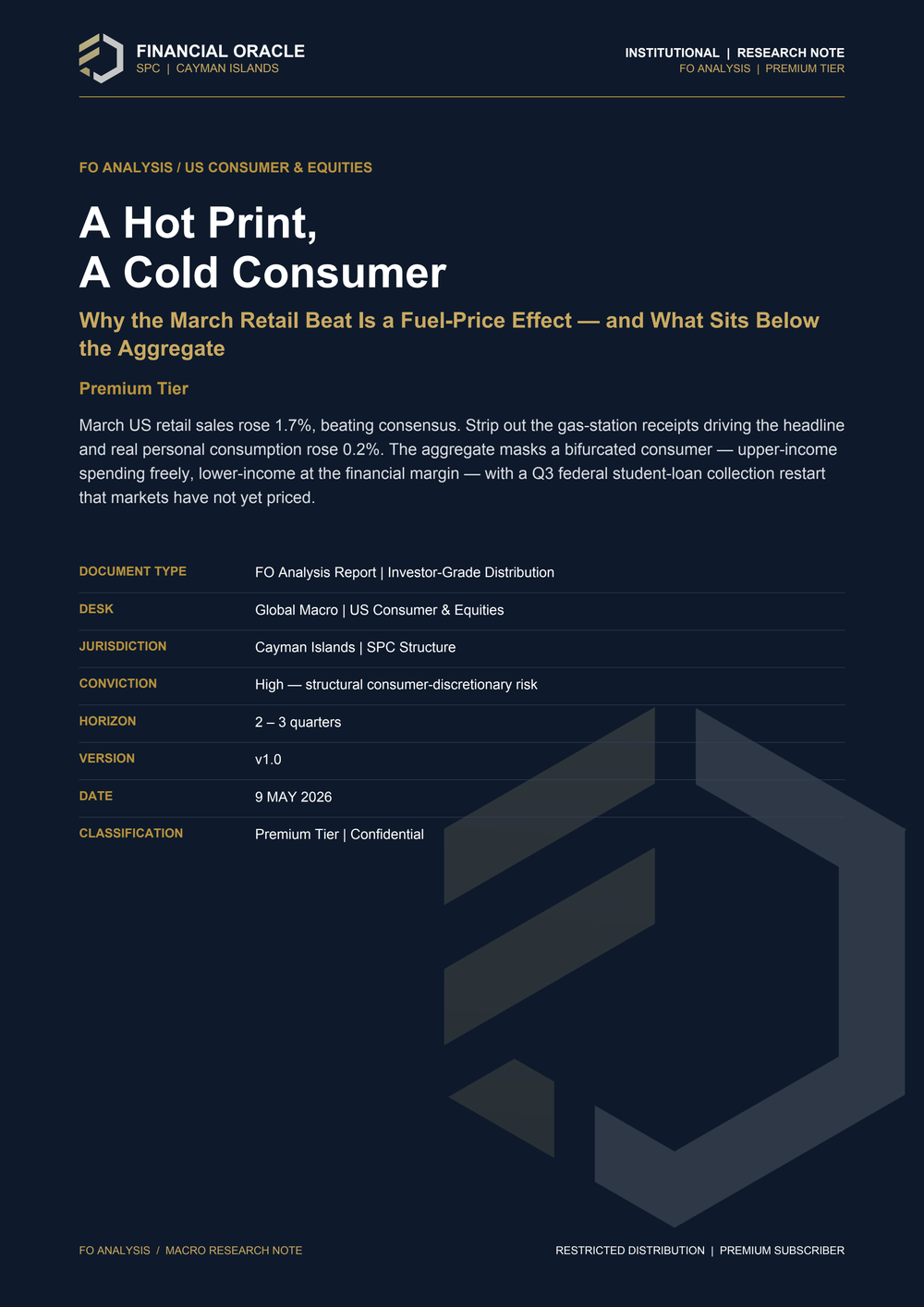 A Hot Print, A Cold Consumer
The retail print is a fuel-price effect, not a consumption signal. Real consumer stress sits at the income tail, where a 3.6% savings rate, $1.28T in revolving credit, and the 2026 federal student-loan collection restart make the third quarter the deciding window for the consumer-discretionary trade.
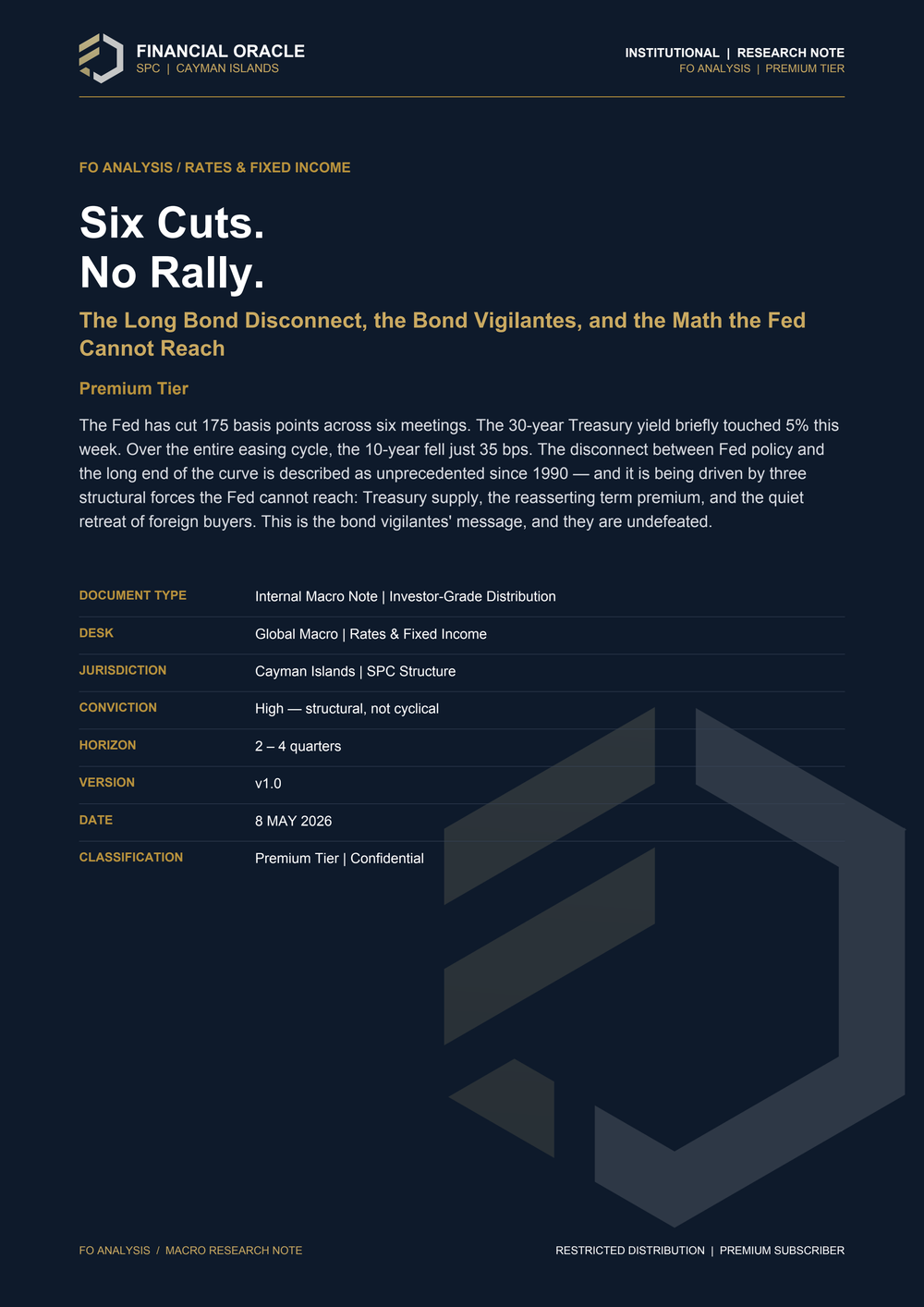 The Long Bond Disconnect
The bond vigilantes are not pricing Fed policy — they are pricing fiscal arithmetic. The Fed controls the price of money overnight. It does not control what a Gulf sovereign reserve fund or a Canadian pension pool demands to lend the U.S. government money for thirty years. Right now, they are demanding more.
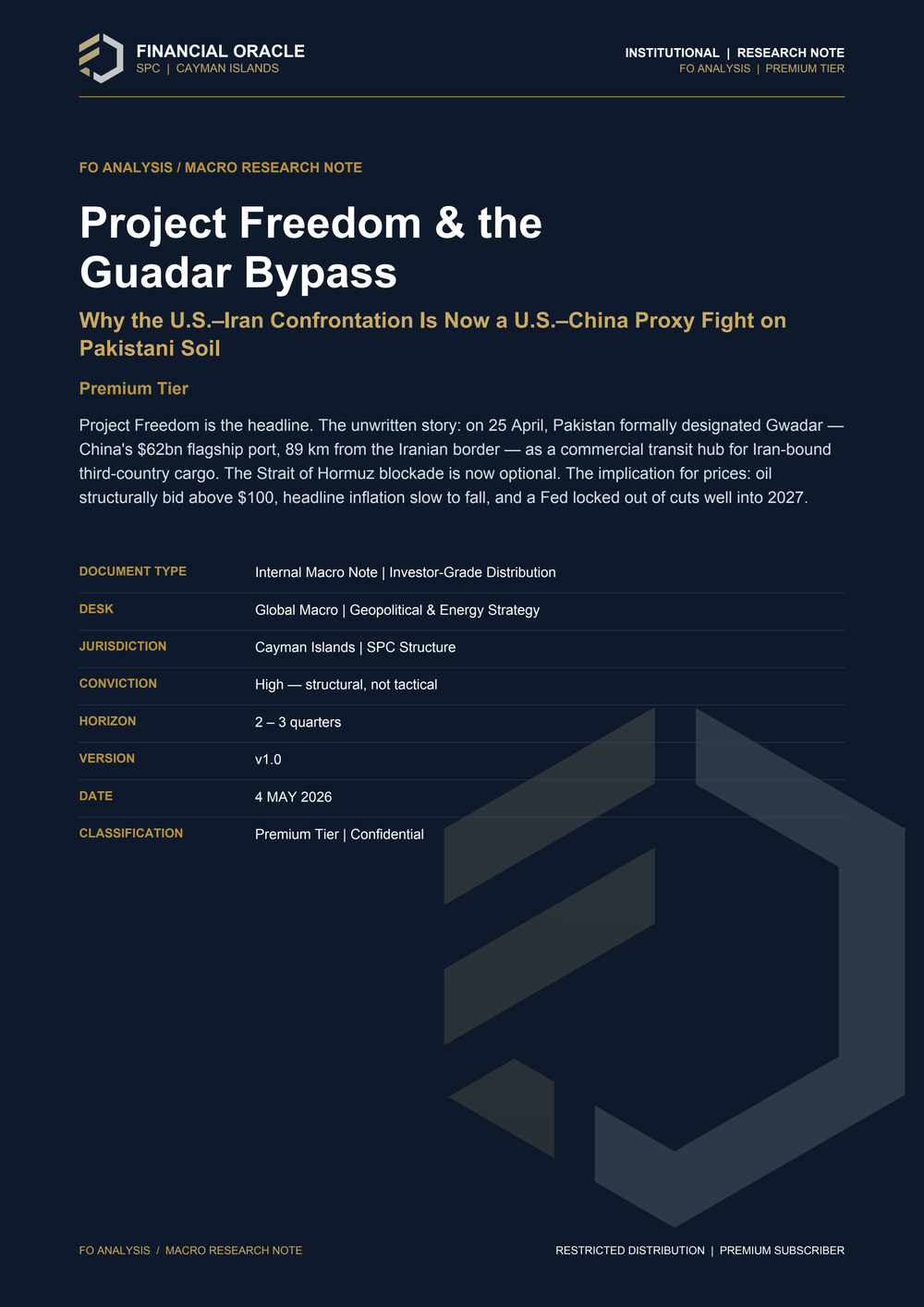 Project Freedom & The Guadar Bypass
This is no longer a bilateral U.S.–Iran story. It is a U.S.–China proxy confrontation being fought on Pakistani soil — and the battlefield is the price of oil and the inflation print that determines whether the Federal Reserve has any room to ease.
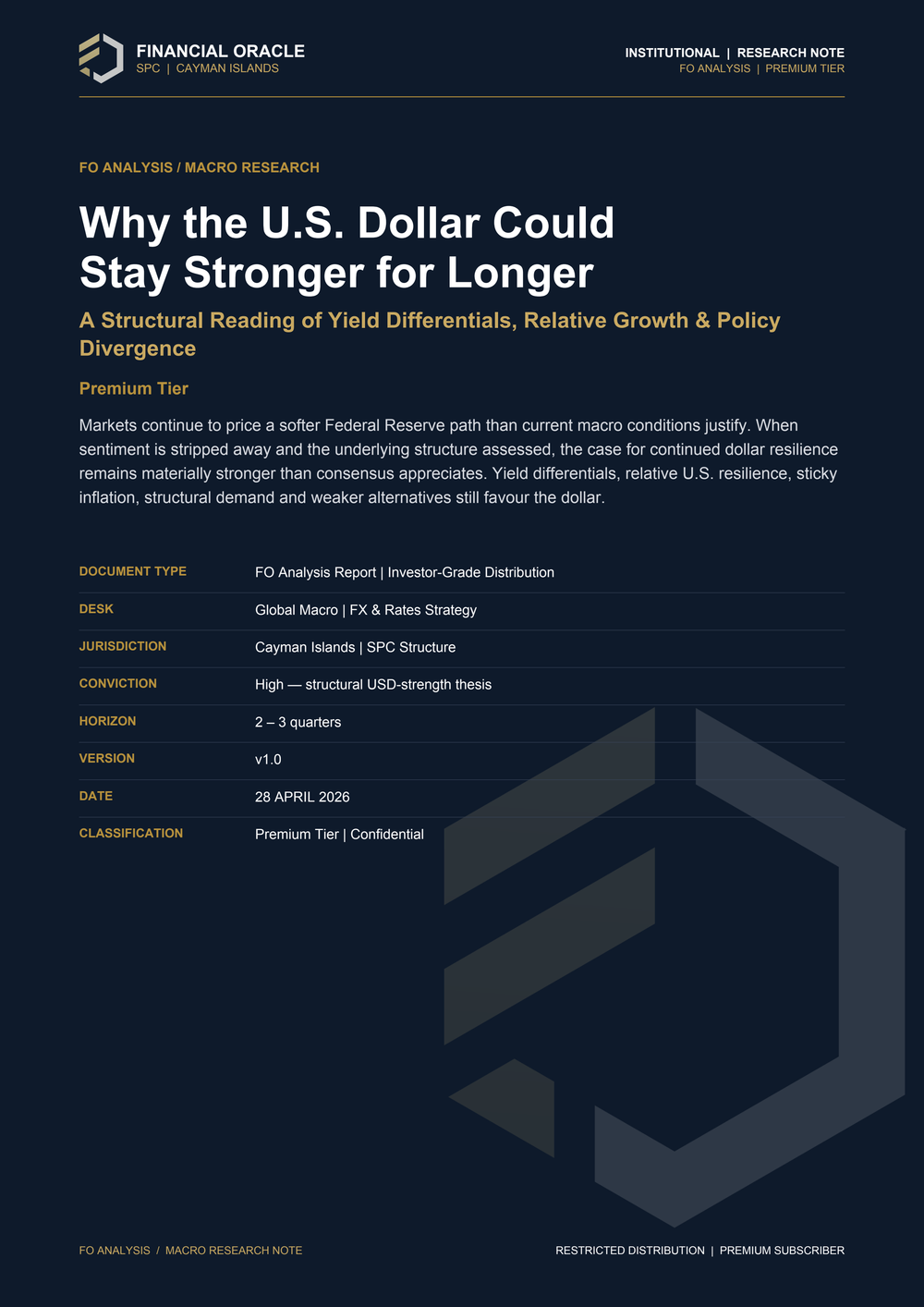 Why the U.S. Dollar Could Stay Stronger for Longer
The dollar does not require explosive bullish catalysts — it only requires the rest of the world to remain relatively weaker. That is often enough. The asymmetry favours the dollar.
 FO Market Breakdown — Dollar Strength, Oil Inflation & Higher-for-Longer Rates
If oil stays elevated, inflation risk stays alive. If inflation risk stays alive, the Fed cannot rush into cuts. If the Fed cannot cut, the U.S. dollar remains supported.
 UAE Exit from OPEC & OPEC+
The exit is about national sovereignty over production policy, not a directional call on oil. The first-order narrative — fewer producers means more supply means lower oil — misses the second-order story. Cartel fragmentation during a war-driven energy shock raises volatility and inflation uncertainty, which keeps the Fed cautious and the dollar bid. The biggest signal from here is not the headline itself — it is Saudi Arabia's response.
No reports match the selected filters.
Receive every report at the source.
Premium and Institutional, with a free email list for every note’s teaser. One publication, structured access.