Research
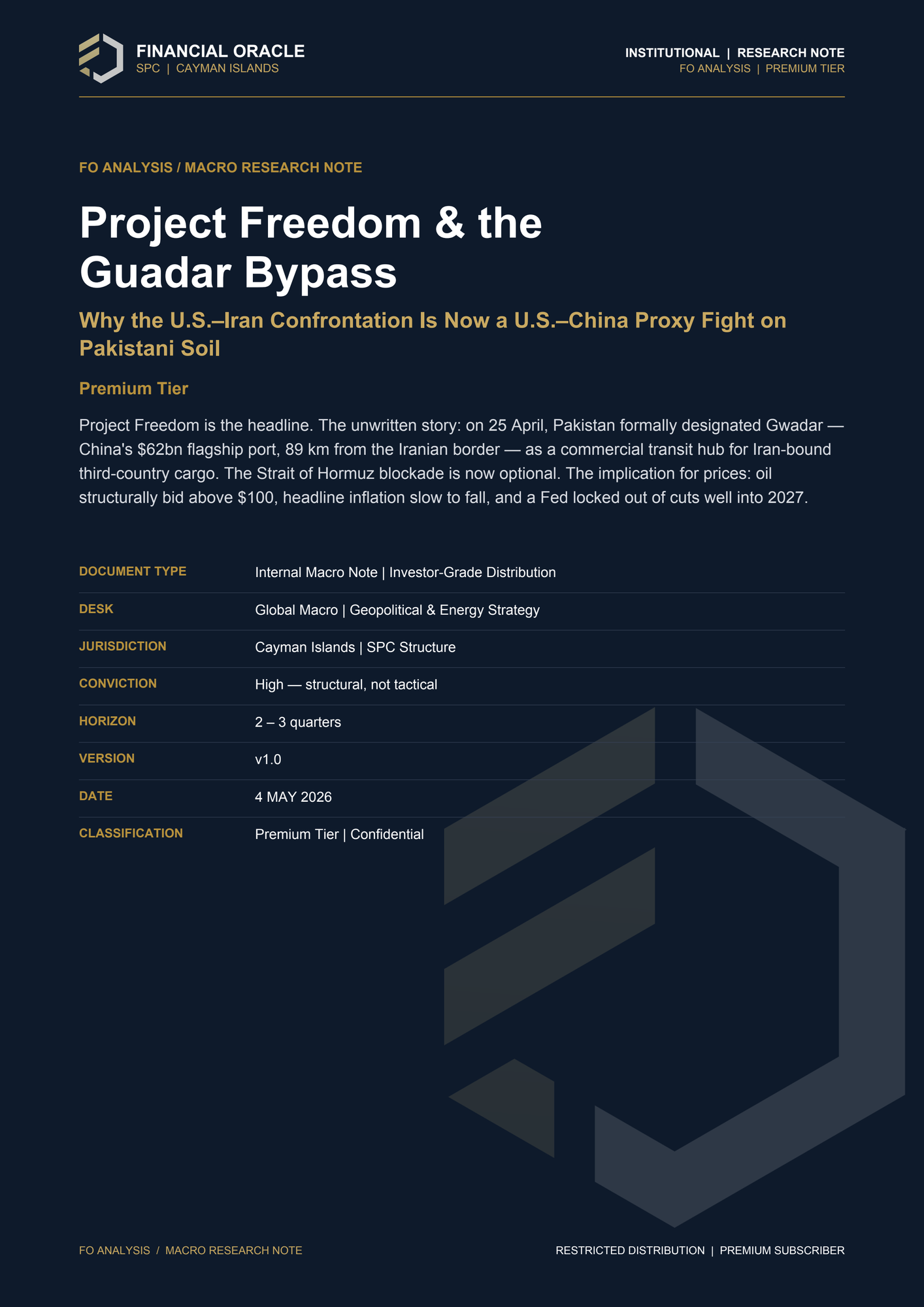
Project Freedom & The Guadar Bypass
Why the U.S.–Iran Confrontation Is Now a U.S.–China Proxy Fight on Pakistani Soil
Project Freedom is the headline. The unwritten story sits 89 km from the Iranian border, at Gwadar — China's $62 billion flagship port — which Pakistan formally designated on 25 April as a commercial transit hub for Iran-bound third-country cargo. The Strait of Hormuz blockade is now optional.
| Continue Reading · FO Premium |
| The rest of this note is for Premium subscribers. |
| You have read the verdict and the data spine of Project Freedom & The Guadar Bypass. What follows is the desk's full read: the argument, the paths and what would prove them wrong. |
| ✓The Story Wall Street Hasn't Priced: the full section, every level dated and sourced. |
| ✓Read the full desk read — subscribe to FO Premium: the complete read behind the desk. |
| ✓The Desk Read in Full: in full, with the reasoning shown. |
| ✓The Strait, Project Freedom & the Market Read: the desk's calibrated read, unabridged. |
| ✓Pakistan, Gwadar & the China Land Corridor: complete, with what would change the view. |
| ✓The China Side of the Trade: the full section, every level dated and sourced. |
| ✓Why the Consensus Oil Path Breaks: the complete read behind the desk. |
| ✓3 data tables: the fact rows, scenario maps and scorecards the argument stands on. |
| ✓2 charts and exhibits, desk-built from primary data. |
| Recently Published · Premium Only |
| 25 August 2026Three Hands. One Pen.The Jackson Hole pre-registration: five tests published before the events, scored after. |
| 18 August 2026The High-Water Mark.The desk scored its own miss at full weight and redrew the thirty-year operating range. |
| 20 August 2026Ten Dollars Offered. One Accepted.The buyback doubling read as signal, not flow: the 10-to-1 queue and the auction that tailed anyway. |
| Every published desk call is dated before the print and scored after it, misses included. Inspect the record before you pay for it → |
| Subscribe to FO Premium |
| Editorial-grade macro research, written for sophisticated readers. Notes land when the data warrants. New to the mechanics? The Learn section is open to everyone. |

The research is Premium. The record is public.
Every Brief and Analysis in full: the scenario maps with explicit invalidation, the cross-asset tactical reads, the desk-formatted PDFs, and a scorecard where every call is dated before the print and scored after it, misses included. Inspect the record before you pay for it.
Subscribe to Premium →Not ready? Get the teasers by email, free · New to the mechanics? Learn is open to everyone.