FO Research / Premium
Premium
research.
All FO Research reports filed under Premium.
20 reports filed under Premium
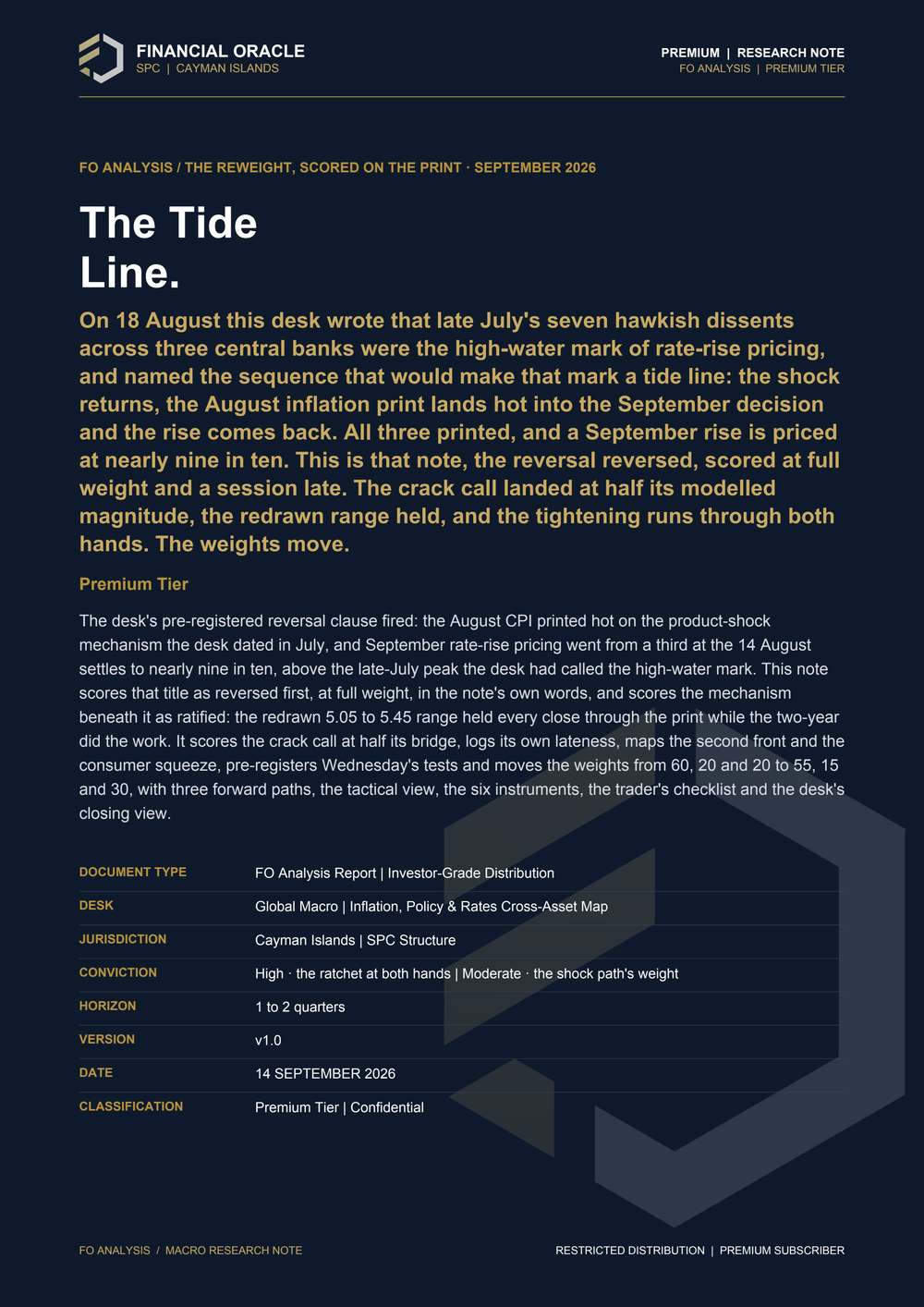 FO Analysis: The Tide Line.
On 18 August this desk wrote that late July's seven hawkish dissents across three central banks were the high-water mark of rate-rise pricing, and named the sequence that would make that mark a tide line: the shock returns, the August inflation print lands hot into the September decision and the rise comes back.
 FO Analysis: The High-Water Mark.
On 3 August this desk pre-committed: if a September rise slid below half and stayed there, the seven hawkish dissents were the high-water mark, and the desk would write that note.
 FO Analysis: The Ratchet.
Crude round-tripped ten dollars in four sessions and the odds of a rate rise gave back only a fraction of their tripling.
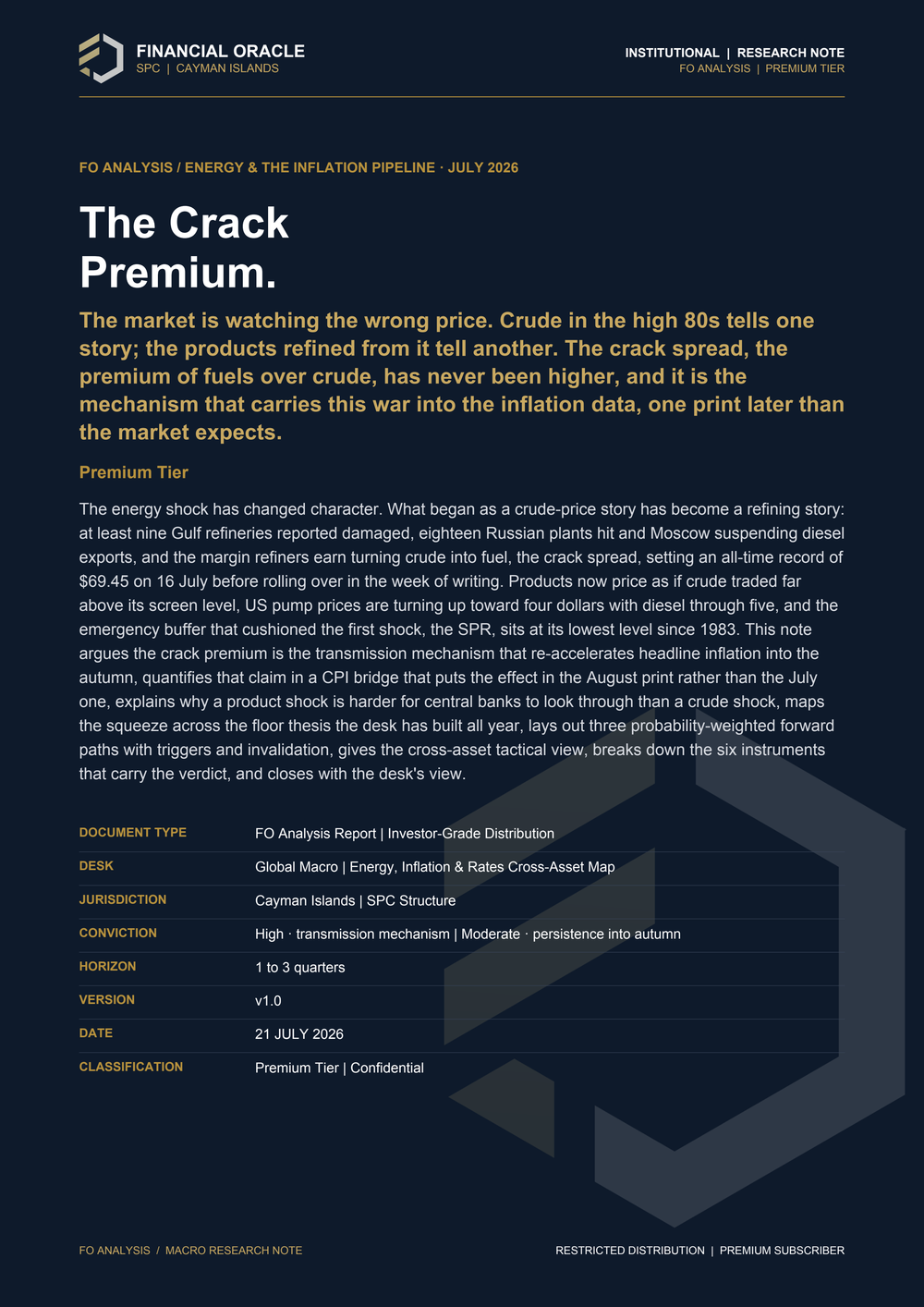 FO Analysis: The Crack Premium.
The shorthand: crude is the price on the screen, products are the price the economy pays, and the gap between them set a record on 16 July before rolling over this week. That gap is the transmission, it reaches the consumer with a lag of one to three weeks, and it lands in the August inflation print rather than the July one.
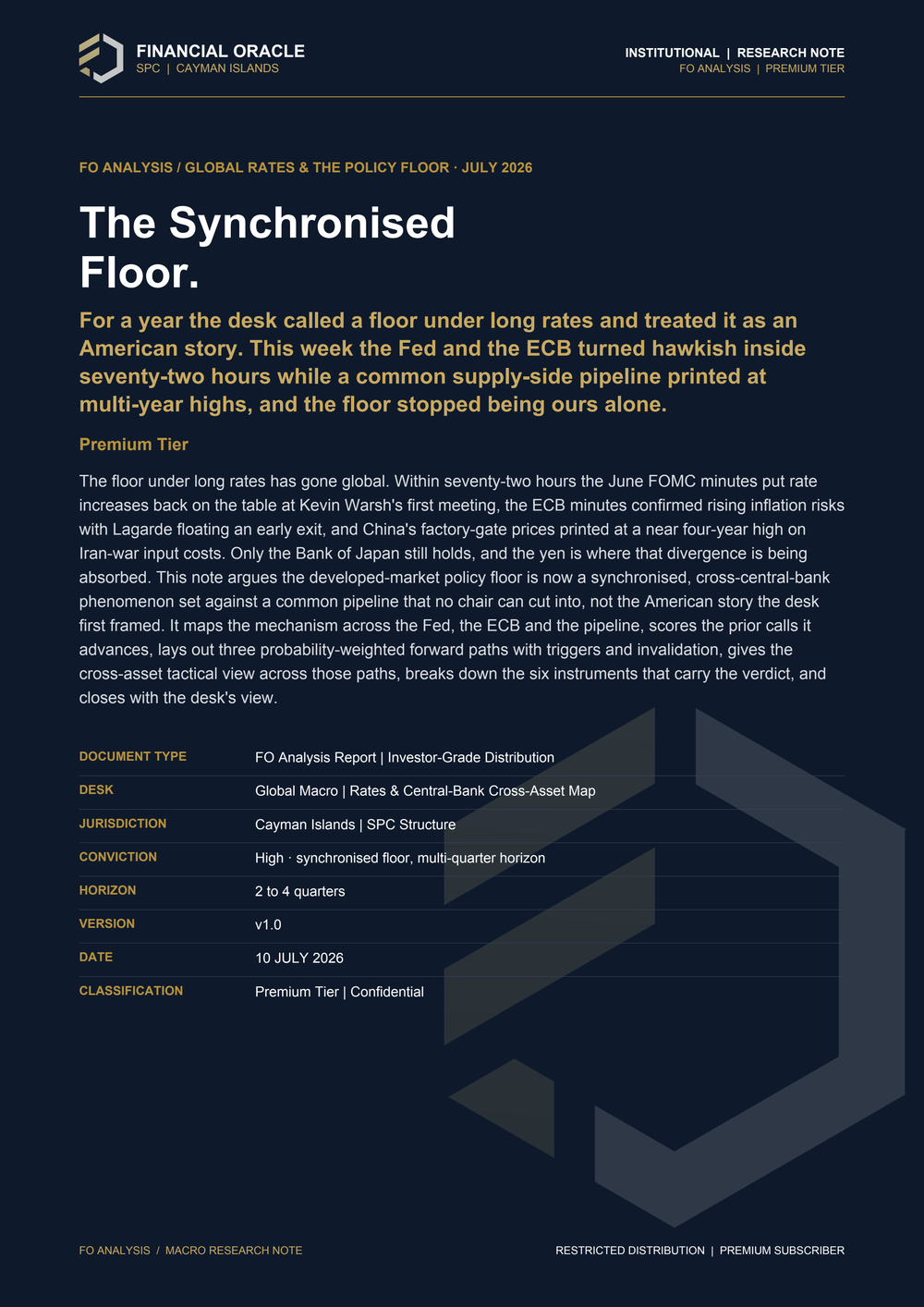 FO Analysis: The Synchronised Floor.
The shorthand: the long end holds its band while the Fed and the ECB turn hawkish in the same week and the pipeline stays firm beneath them, and only the Bank of Japan still holds. The floor under long rates is no longer a US idiosyncrasy. It is a synchronised, cross-central-bank regime, and the yen is where the one holdout's divergence is being paid.
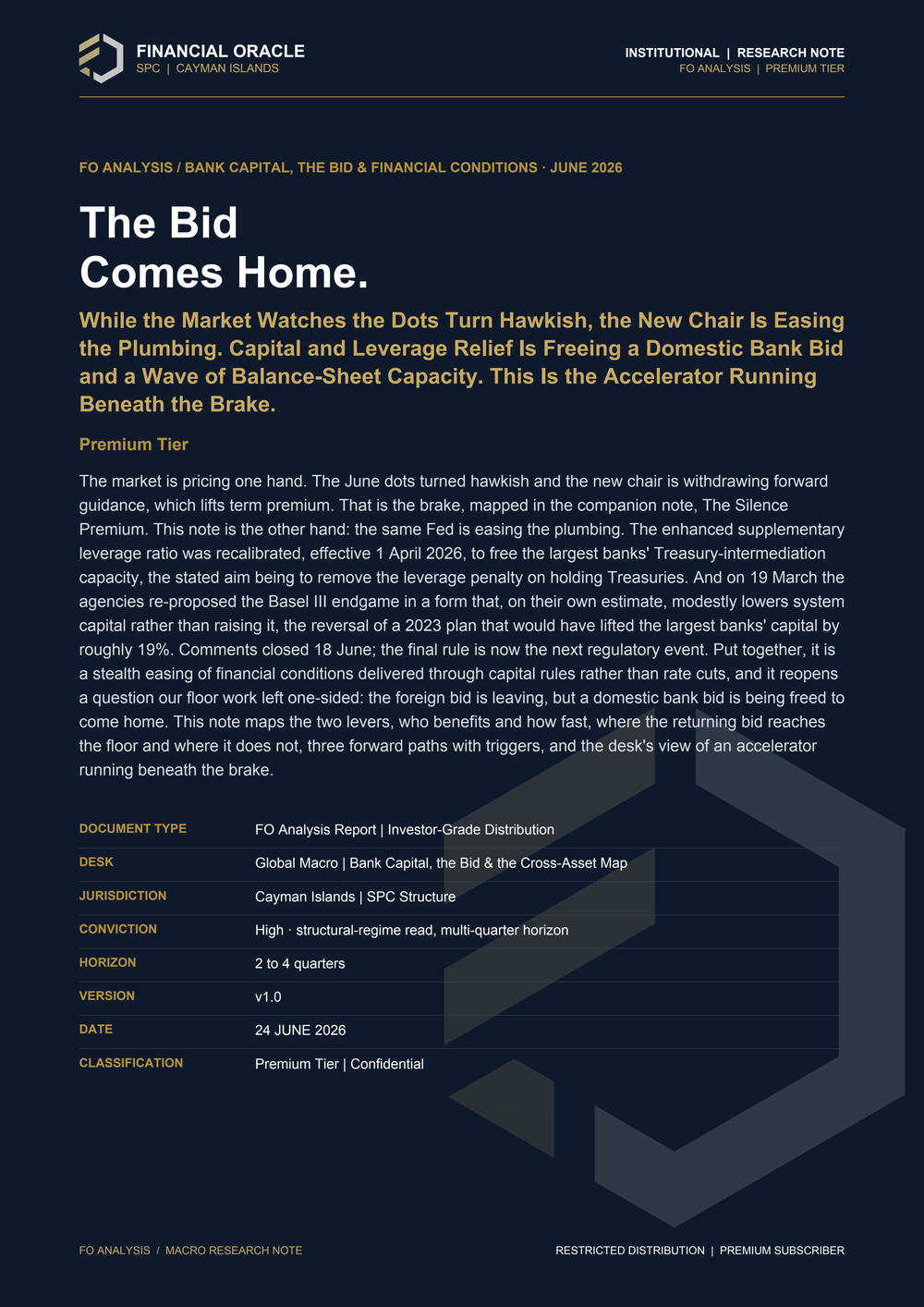 FO Analysis: The Bid Comes Home.
The shorthand: the Fed is running the brake and the accelerator at once. The brake is the rate hand, hawkish dots and a guidance withdrawal that lifts term premium. The accelerator is the capital hand, a leverage relief already in force and a Basel re-proposal that cuts rather than raises capital, freeing a domestic bank bid and a wave of balance-sheet capacity. Banks are rising into higher rates because equity already prices it. The honest limit: the returning bid skews short, so it eases the front end, the plumbing and credit more than the 30-year. The floor still needs term premium to turn. Same floor, new cross-current.
 FO Analysis: The Silence Premium.
The shorthand: forward guidance was a term-premium suppressant, and the new chair is removing it. The 30-year sits near 4.94%, the front end anchored near 4.21%, the curve steep at +70bp, and the 10-year breakeven still near 2.21%. Firm long yields with flat breakevens is a premium story, not an inflation one. The floor under long rates does not fall when the Fed goes quiet. It gains a new leg. Same floor, higher premium.
 FO Analysis: The Buyers Go Home.
The shorthand: a credible ceasefire framework arrived and the 30-year held 4.97%, higher on the week, not lower. The Bank of Japan lifted its policy rate to 1.00%, a 31-year high, and cut its bond buying. Credit compressed (HY OAS 2.71) rather than widened, so this is not a fear trade. USD/JPY barely moved at 160, so the carry unwind is a slow burn, not yet a shock. The war premium leaving could not lift the long end off the floor, because the floor is the vanishing buyer, not the conflict. Warsh meets that floor tomorrow.
 FO Analysis: The Floor Held. Again.
The shorthand: core m/m 0.2% (soft, vs 0.3% consensus), headline y/y 4.2% (the base-effect re-acceleration, dead on), the 2-year unchanged at 4.14%, the 30-year holding 5.01% above the floor, gold off 2.4% on higher real yields, the dollar firm, the VIX higher, and an AI complex that was already selling into the print and that a dovish core could not rescue. A soft core is necessary for a dovish turn. It is nowhere near sufficient.
 FO Analysis: Held Out for the IPOs.
The shorthand: Nasdaq -4.2% Friday with a record point drop, S&P 500 -2.65% for a ~$1.8T market-cap wipeout, SOX -8.8%, VIX +39%, HY OAS 2.76 close (from 2.74 prior; credit refused to widen), Alphabet announcing a ~$80bn equity raise to help fund $180-190bn of 2026 capex, Anthropic confidentially filing for IPO at a ~$965bn last private mark, and the mainstream reporting cycle picking up the mechanism: model routing. The era of one model at premium price is being tested. The IPO valuations resting on that era are the cleanest tell on which way it breaks.
 FO Analysis: Six Pillars. One Regime.
The shorthand: April core PCE 3.3% on the year, the 30-year sitting on 5%, the front end pricing relief the long end will not ratify, Brent back through 93, USD/JPY 159, semis a record share of the S&P, and credit spreads 272bp tight. Six pillars active, one regime.
 FO Analysis: The Last AAA
We called the structural long-end disconnect on 8 May. The rating action is the institutional ratification of that thesis, not a new one. The forward leg it activates, the part the consensus is not pricing, is the mandate channel: the marginal, price-insensitive, mandate-constrained buyer of size now has a technical reason to step back, independent of view.