Regime
FO Analysis: The Ratchet.
THE VERDICT
The Shock Is Not the Story. The Response Is.
Last week the market ran an experiment no desk could have commissioned. Crude spiked seven per cent in a day to the first three-figure Brent settle of this leg, and then a weekend pause in the strikes took all of it back and more: ten dollars up, twelve down to a Monday settle below where the spike began, inside four sessions. If policy were reacting to the level of the shock, the probability of a rate rise at Wednesday's meeting should have round-tripped with the barrel. It did not. It ran from 10.7% before the spike to 38% at the top, touched 40% during the very session in which crude completed its round trip, and stands at 35% on decision eve, more than three times where it started. Singapore's central bank tightened on Monday morning, into the falling oil price. The ECB held last week while naming energy volatility. The Bank of England carries two live votes for a rise into Thursday, and the Bank of Japan is reported open to a faster pace into Friday. The desk names the mechanism this note is built on: the ratchet. Policy no longer responds to the level of the shock. It responds to the recurrence, and each shock leaves the stance tighter than it found it.
| DATA POINT | AS OF / NOTE | |
|---|---|---|
| Odds of a 29 Jul rate rise (pre-spike) | 10.7% | 15 Jul 2026, market-implied via fed funds futures, press-reported |
| Odds of a 29 Jul rate rise (spike) | 34.7% to 38% | 22 to 24 Jul 2026, tripling inside a week as Brent ran to its settle high |
| Odds of a 29 Jul rate rise (post-fade) | ~35% | 35.4% per fed funds futures, 28 Jul 2026 02:35 ET; touched 40% during Monday's crude slide before easing (Reuters, 27 Jul). More than three times the pre-spike level |
| Fed funds target range | 3.50 to 3.75% | Unchanged since the December 2025 cut; a hold on 29 Jul would be the fifth consecutive |
| June projections showing a 2026 hike | 9 of 18 | FOMC Summary of Economic Projections, 17 Jun 2026; six of the nine show two or more; median end-2026 rate 3.8% |
| Brent crude (the spike) | $100.69 settle | 23 Jul 2026, +7% on the day, intraday above 102, highest since May |
| Brent crude (the fade) | 96.78 then $88.36 settle | 24 and 27 Jul settlements: Monday closed below the 91.01 pre-spike settle of 21 Jul. The round trip completed, and more |
| 3-2-1 crack spread | $69.45 record; $62.22 last settle | 16 Jul record; dipped to 59.07 on 24 Jul, re-widened to 62.22 at the 27 Jul settle as crude fell harder than fuel. Corrected 30 Sep 2026 to one delivery month per session. FO computation from NYMEX |
| US 2-Year yield | 4.21 to 4.36 to 4.33% | 20 Jul to 23 Jul peak to 27 Jul final print: kept four-fifths of the spike's hike risk through the fade |
| US 30-Year yield | 5.12 to 5.17 to 5.14% | Same dates, final prints: five basis points up, three back, never outside the 4.85 to 5.20 band |
| US 10-Year breakeven | 2.21% | 27 Jul 2026: rose to 2.28 with the spike and round-tripped with it, ending below the 2.25 pre-spike print. The honest exception, treated in the body |
| US HY OAS | 2.79% | 24 Jul 2026: +9bp on the spike day and a further 2bp Friday. A drift off the tights, not a gap |
| Singapore policy move | Slope steepened, into the fade | 27 Jul 2026: MAS raised the S$NEER band's rate of appreciation, a surprise against the analyst poll, second tightening in three months, citing oil-driven inflation risk |
| ECB decision | All three rates held | 23 Jul 2026: deposit 2.25%, main refinancing 2.40%, marginal lending 2.65%; statement names energy volatility and Middle East tensions |
| New tariff round | 17 at 10%; 5 net-of-MFN; 38 at 12.5% | Effective 24 Jul 2026 under Section 301, the day the Section 122 surcharge lapsed. Verified against the primary record (USTR, 23 Jul; 91 FR 47318, 28 Jul): 10% flat on 17 named economies; EU and Taiwan at a 10% net-of-MFN threshold with Japan, Korea and Switzerland at 12.5%; the remaining 38 at 12.5% flat |
| DRAM spot prices | ~+700% year on year | July 2026 reporting; memory now roughly 35% of a laptop's bill of materials; PC makers raising prices 15 to 20% |
| USD/JPY | ~163.8 | 24 Jul indicative close; the release valve, into a BoJ meeting reported open to a faster pace |
| Gold | $4,074.50 settle | 27 Jul 2026, off the 22 Jul spike high near 4,166: resilient through de-escalation, a policy-risk bid rather than a war bid |
Data timing: every market level in this note is a settlement or day-final print through Monday 27 July 2026. Treasury yields are the Federal Reserve's daily series at day-final values, through 27 July; the desk notes that same-day rows on this feed post provisionally and firm the next day, and only next-day-confirmed prints are used. The breakeven is final through 27 July and credit through 24 July on their own schedules. Brent, WTI and the crack spread are exchange settlements through 27 July, the crack the desk's own front-month computation. No unsettled Tuesday cash-market price is used as a print: the only live Tuesday figure is the explicitly timestamped rate-probability reading of 35.4% as of 02:35 ET on 28 July, and the chart's dashed Tuesday tail is marked unsettled and carries no value. The rate-probability readings are otherwise market-implied from fed funds futures as reported on the dates shown. Positioning is the CFTC report as of 21 July, which captures the build into the spike and cannot yet show the fade.
The data points above are the data spine of this Premium. Throughout the body the desk labels material as Confirmed (a sourced primary fact), Observed (a live market level), FO inference (the desk's read), or FO risk scenario (a forward path under specific triggers). When in doubt, follow the labels.
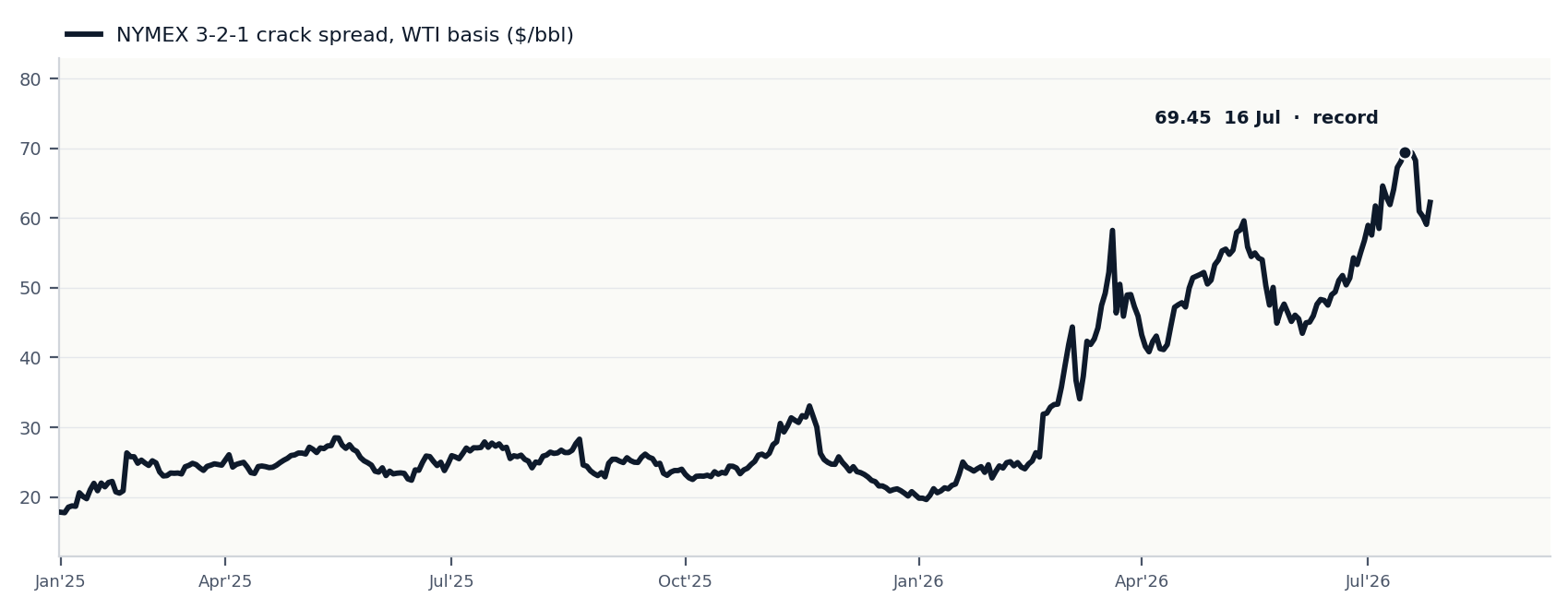
The chart is the setup, not the thesis. The desk's own crack series shows the July squeeze splitting into two legs: the record printed on 16 July, the margin dipped five dollars from the top as the desk's prior note flagged, and then Monday's settle re-widened it to within eleven cents of its pre-spike level as crude fell harder than fuel. The crude leg of the shock round-tripped. The refining leg did not, and neither did the policy stance either leg produced. On the old reading of central banks, a fading shock buys relief; the whole of this note is that the old reading is wrong, and the gap between the fading barrel and the unmoved stance is where the next two quarters of rates trade lives.
THESIS PERFORMANCE · SCORED AGAINST THE TAPE
What Ratified. What Is Advancing.
A Premium thesis is only as good as its performance record. Subscribers should expect this scorecard in every Premium.
| CALL | STATUS | WHAT HAPPENED |
|---|---|---|
| The Crack Premium (21 Jul, Premium): the refining margin is the transmission; watch the crack and why it moves, with normalisation on de-escalation named as the benign path. | ADVANCING | The tell part-fired: the crack dipped five dollars from its record on a genuine de-escalation and the desk moved weight toward the benign path, then Monday's settle re-widened the margin as crude fell harder than fuel. The crude leg resolved; the refining leg persists. The weight shift is checked, not confirmed; the floor call beneath it strengthened. |
| The Disinflation Arrives. The Floor Doesn't Break. (15 Jul, Brief): June's relief leaned on an energy dip that had already reversed and might prove one print wide. | EVOLVED | The reversal came, ran to a 100.69 Brent settle, and partly unwound on the pause. The timing was re-dated to the August print in the 21 Jul Premium; the magnitude now tracks between that note's base and benign paths. |
| The Synchronised Floor (10 Jul, Premium): the floor is a cross-central-bank regime set against a common supply pipeline. | ADVANCING | One week produced an ECB hold naming energy, two live BoE hike dissents, a BoJ reported open to a faster pace and a surprise Singapore tightening into a falling oil price. The regime is printing on four desks at once. |
| The Silence Premium (23 Jun, Premium): a constrained Fed with limited room to ease keeps a floor under long rates. | ADVANCING | The constraint is now visible in market pricing: a one-in-three hike probability into Wednesday and a two-year 58bp above the ceiling. The floor held a ten-dollar round trip in crude without leaving its band. |
| A Pipeline, Not a Spike (13 May, Premium): inflation is a broadening supply-side process, not an energy pop that clears. | ADVANCING | The pipeline now runs three engines at once: energy that keeps returning, a tariff wall rebuilt inside months of being struck down, and a chip-cost squeeze locked in until 2027. The process broadened exactly as argued. |
The row to read twice is the first one. The 21 July Premium told readers to watch the crack spread and the reason it moved, named normalisation on de-escalation as the benign path, and pre-committed the desk to cutting its weight if the settlements confirmed the roll. They did, the desk cut it in print within the week, and the deeper call strengthened while the narrower one evolved. That is what the scorecard is for. The desk would also flag what did not print as sketched: the benign path was drawn with the front end pricing relief first, and the front end has instead held its hike risk through the fade. That divergence is not an embarrassment to the framework. It is the finding, and this note is built on it.
The full desk read continues below for Premium subscribers: the Regime Dashboard, the dated ratchet ledger (six disturbances, six responses, not one reversal), the probability-weighted Scenario Map for Wednesday's Fed decision with an explicit thesis invalidation, the committee map, the three supply engines quantified, the FO Tactical View, the Cross-Asset Breakdown, how the desk expresses it, the Trader's Checklist, the glossary, and the Premium PDF.
| Continue Reading · FO Research Premium |
| The rest of this note is for Premium subscribers. |
| You have read the verdict, the data spine and the scored record. What follows is the part that carries the money: the ratchet ledger, the three weighted paths into Wednesday with their invalidation, and the cross-asset map. |
| ✓The ratchet ledger: six dated supply disturbances since the spring, the policy response to each, where the shock stands now, and where the stance stands. The mechanism in evidence form. |
| ✓The odds ladder: how a rate-rise probability tripled on the oil spike and kept most of the move through the fade, with every reading dated and its status labelled. |
| ✓Wednesday's Fed decision mapped across three weighted paths, hawkish hold, hike, relief, with triggers, market reactions, invalidation, and the condition under which the desk retires the thesis. |
| ✓The committee map: nine of eighteen June projections carrying a rise, the named hawks, and the chair who did not submit a dot. |
| ✓The three supply engines quantified: energy fading, a tariff wall rebuilt inside months with pass-through estimates attributed, and a chip-cost squeeze locked in until 2027. |
| ✓The September measurement change that cuts against the desk's own autumn view, owned in-body with the CPI-versus-PCE distinction stated. |
| ✓Confirmed / Observed / FO Inference / FO Risk Scenario labels throughout, separating sourced facts from market reads from interpretation. |
| ✓The Regime Dashboard: ten cross-asset signals colour-coded RED / AMBER / GREEN. |
| ✓Positioning read honestly: speculative crude length a third of its March peak, Treasury shorts net of the basis trade, and the caveat that the fade is not yet observable. |
| ✓The FO Tactical View matrix: directional reads across the curve, breakevens, crude, credit, equities, the dollar and the yen, across all three paths. |
| ✓The Cross-Asset Breakdown: the six instruments that carry the verdict, including gold's quiet change of driver. |
| ✓The Trader's Checklist for a week with three central bank decisions, the Fed's preferred inflation gauge and the first read of Q2 growth. |
| ✓The glossary: plain-language definitions of the ratchet, the reaction function, the dots, the release valve and the rest. |
| ✓The full Premium PDF, desk-formatted for print and offline reading. |
| Recently Published · Premium Only |
| 27 July 2026The Shock Round-Trips. The Floor Doesn't.Crude spiked to Brent 100 and gave it back; the long end held its band and rate-rise bets kept most of their move. |
| 21 July 2026The Crack Premium.The energy shock moved downstream into refining, and the record margin became the transmission into the inflation data. |
| 10 July 2026The Synchronised Floor.The Fed and the ECB turned hawkish inside seventy-two hours against a common supply-side pipeline. |
| Subscribe to FO Premium |
| Editorial-grade macro research, written for sophisticated readers. Notes land when the data warrants. |

The research is Premium. The record is public.
Every Brief and Analysis in full: the scenario maps with explicit invalidation, the cross-asset tactical reads, the desk-formatted PDFs, and a scorecard where every call is dated before the print and scored after it, misses included. Inspect the record before you pay for it.
Subscribe to Premium →Not ready? Get the teasers by email, free · New to the mechanics? Learn is open to everyone.