Explainer
Gold vs Real Yields: Why They Move Together (and When They Don't)
Gold and real yields normally move in opposite directions. When the real yield on Treasuries falls, gold tends to rise; when it climbs, gold tends to fall. The reason is opportunity cost: gold pays no coupon, so its appeal grows as the inflation-adjusted return on cash and bonds shrinks. That is the relationship. It is not a rule. It is a tendency that holds most of the time and breaks in revealing ways.
The mechanism: gold is a zero-coupon asset
Gold produces no income. It has no yield, no dividend, no coupon. Holding it means giving up whatever a safe alternative would have paid. That alternative is the real yield: the return on an inflation-protected government bond, most cleanly read off Treasury Inflation-Protected Securities (TIPS).
When the real yield is high, cash and bonds pay you a healthy return after inflation, and the cost of holding a zero-coupon metal is steep. When the real yield is low or negative, that cost collapses, and gold looks relatively more attractive. This is why the desk treats the real yield, not the nominal yield, as gold's primary discount rate. Gold is not priced against the headline yield. It is priced against the yield after inflation.
Why real yields, not nominal
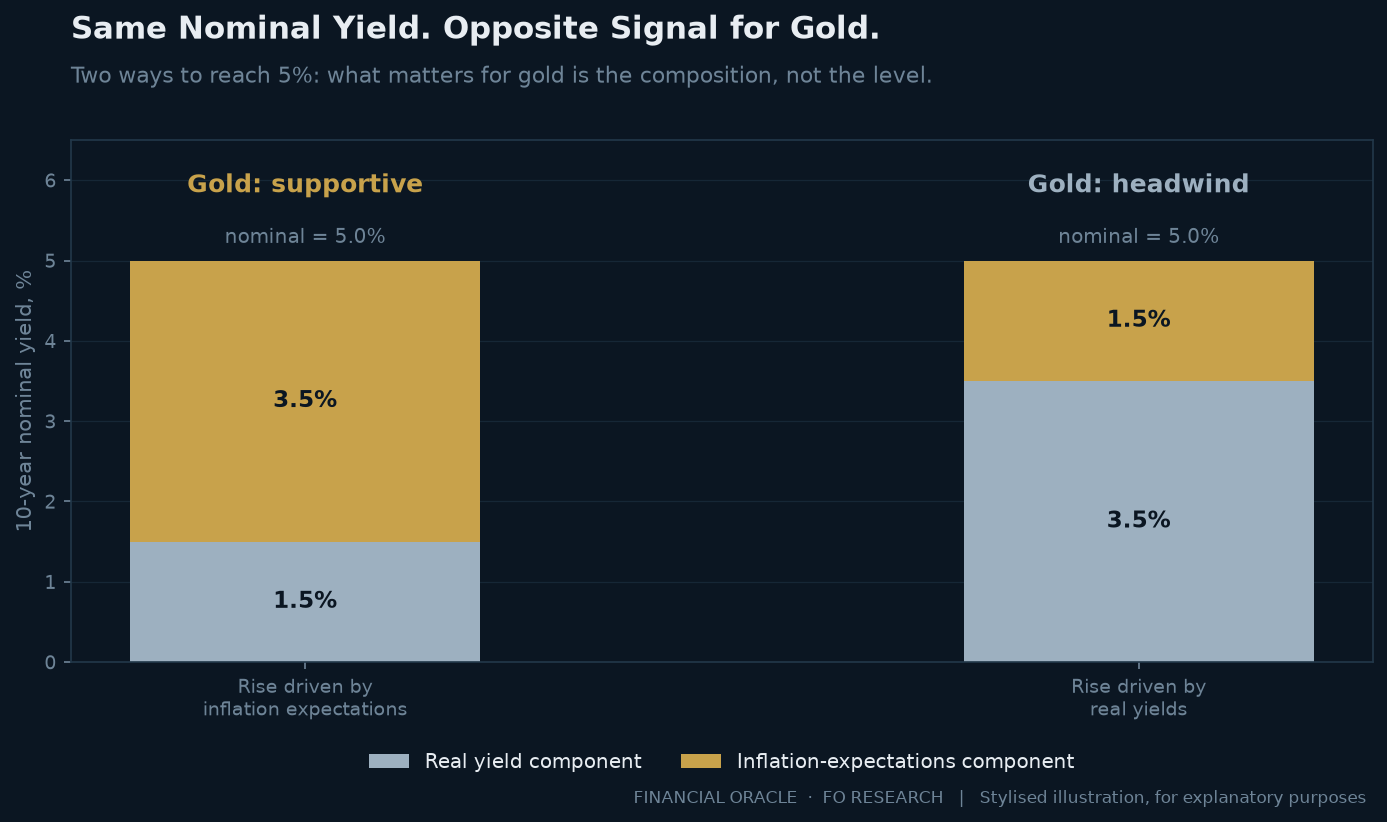
A nominal yield bundles two things: the real return and expected inflation. Gold cares about both, but in opposite ways. Higher expected inflation is, all else equal, supportive of gold. Higher real returns are a headwind. The nominal yield nets them out and blurs the signal. The real yield strips inflation expectations back out and isolates the part that matters for the opportunity-cost calculation.
The practical read: a rising nominal yield driven by rising inflation expectations can sit perfectly happily alongside a rising gold price. A rising nominal yield driven by rising real yields is the one that usually hurts. Same headline number, opposite meaning for gold. It is not the level of yields. It is the composition.
The historical fit, and its limits
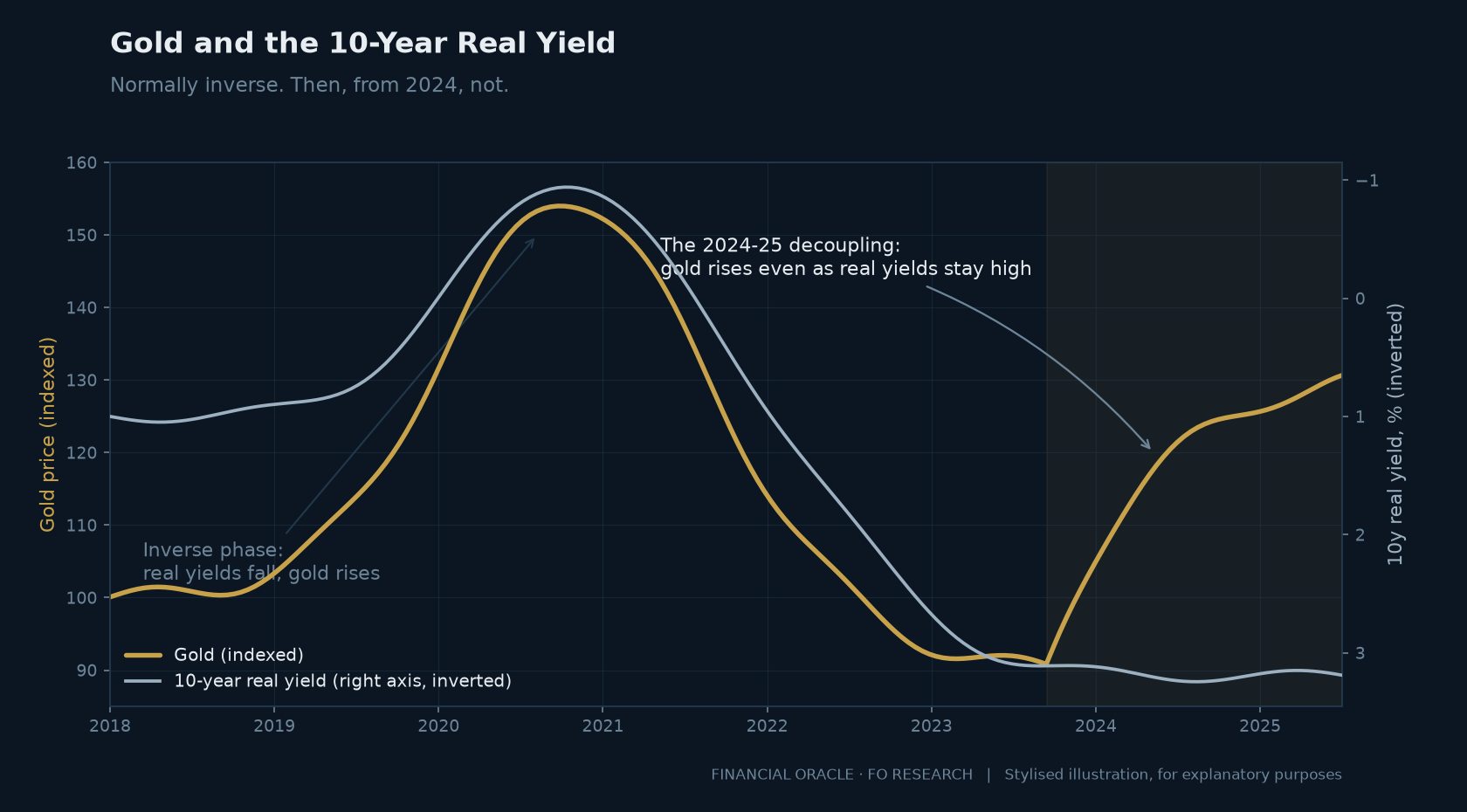
Across most of the post-2008 period the inverse link was tight. Rolling correlations between gold and the 10-year real yield frequently ran in the region of -0.7 to -0.9, negative enough that many desks modelled gold almost mechanically off real rates. The 2011 highs, the 2020 surge to record levels, and the 2013 taper drawdown all fit the template: real yields down, gold up; real yields up, gold down.
That fit is the reason the decoupling that followed is worth understanding. A relationship this reliable does not break for trivial reasons. When it breaks, the break is the tell.
When the link breaks: 2024 to 2025 and the central-bank bid
Through 2024 and into 2025 gold climbed to successive records while real yields stayed elevated. On the textbook relationship, that should not have happened. High real yields were supposed to cap the metal. They did not.
The explanation is a change in the marginal buyer. For most of the modern era the price-setting flow in gold was financial: Western investors expressing a view on real rates, largely through futures and exchange-traded funds. That buyer is rate-sensitive. But since 2022 the marginal buyer has increasingly been official: central banks, led by emerging-market reserve managers, adding gold at a pace not seen in decades. The World Gold Council has recorded annual official-sector purchases above 1,000 tonnes in successive years, roughly double the prior decade's run-rate.
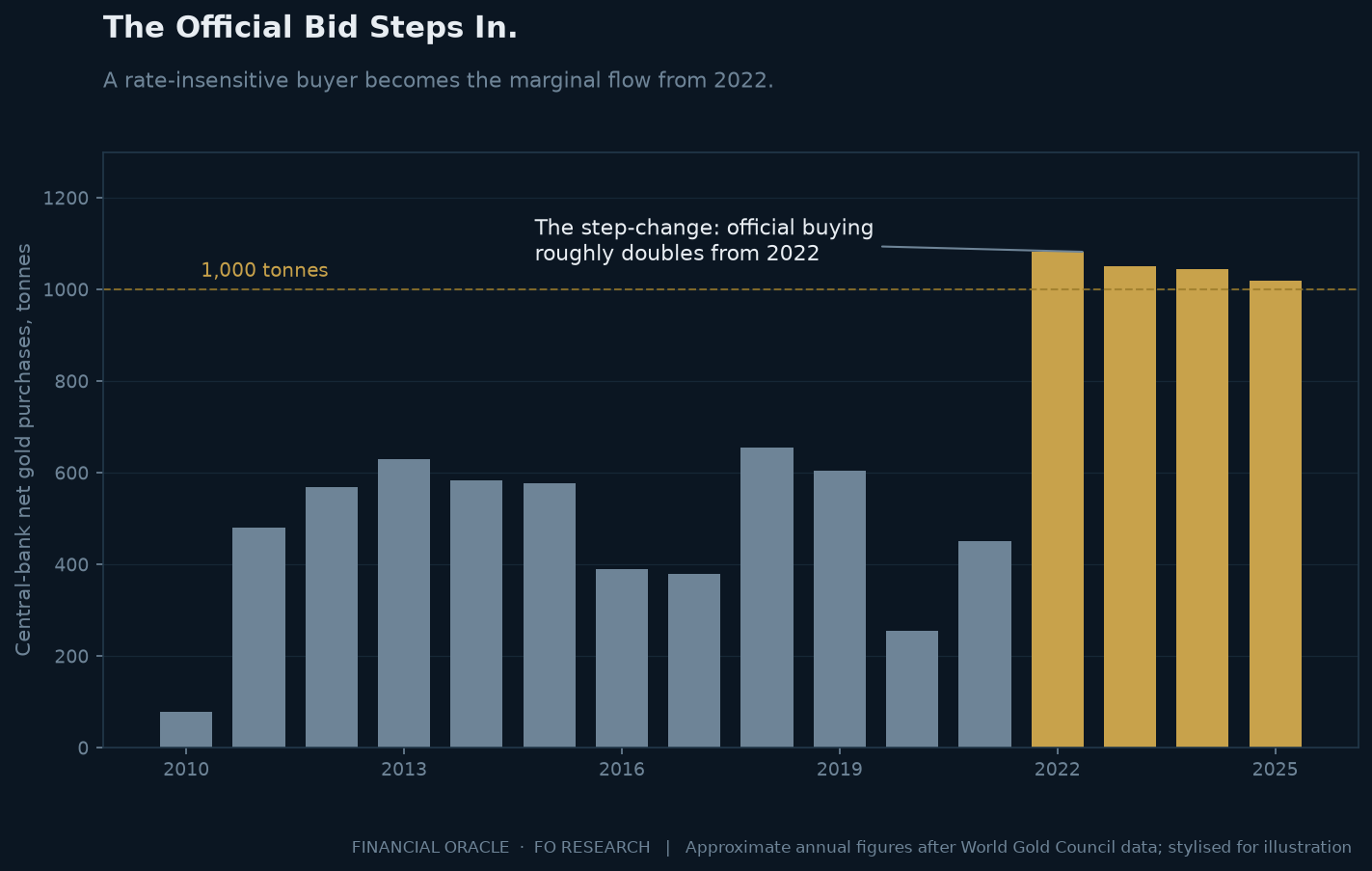
This buyer is not solving an opportunity-cost equation against TIPS. It is diversifying away from dollar reserves for reasons of policy and sanction risk, and it buys through cycles regardless of the real yield. When a price-insensitive buyer becomes the marginal buyer, the old rate-driven correlation weakens. Gold stops trading purely as a long-duration asset and starts trading, in part, as a monetary-reserve asset. It is not that opportunity cost stopped mattering. It is that a second engine was bolted on beside it.
The desk's read is that both engines are now live at once, which is why gold has become harder to model off any single variable and why the real-yield relationship, still intact in direction, has lost some of its former tightness. The desk's dated gold calls, scored against the tape, sit in the track record.
How this fits the cross-asset picture
Gold does not trade in isolation. Its two engines connect directly to the forces the desk tracks elsewhere. The real-yield engine ties gold to the same structural level under long rates that the desk has called the floor: if real yields are held up by a heavy Treasury supply and a thinning buyer base, that is a headwind the financial buyer of gold has to fight. The reserve-asset engine ties gold to the dollar: the same reserve managers diversifying into gold are, at the margin, the mirror image of the structural dollar story the desk laid out in Why the U.S. Dollar Could Stay Stronger for Longer. Gold sits at the intersection of both, which is why it appears as its own pillar in the desk's regime map.
Is gold an inflation hedge?
Over long horizons, broadly yes; over short horizons, unreliably. Gold has preserved purchasing power across decades, but it can fall in real terms for years at a stretch, and it has repeatedly lagged in the early phase of an inflation shock precisely because central banks respond to that shock by raising real yields. The cleaner framing is the one above: gold hedges against low or falling real yields and against loss of confidence in fiat reserves. Those often accompany inflation, but not always at the same time. Gold is not an inflation hedge in the simple sense. It is a real-yield and monetary-confidence hedge that inflation frequently, but not automatically, triggers.
Frequently asked questions
Why does gold go up when real yields fall?
Because gold pays no income, its main cost is the return you forgo by not holding a safe, inflation-protected bond instead. That forgone return is the real yield. When real yields fall, the cost of holding gold falls, and gold becomes relatively more attractive. When they rise, the reverse.
Why did gold and real yields decouple in 2024 to 2025?
The marginal buyer changed. Central banks, led by emerging-market reserve managers, bought gold at above 1,000 tonnes a year to diversify away from dollar reserves. That buyer is not rate-sensitive, so heavy official demand lifted gold even while real yields stayed high, weakening the usual inverse link without reversing its direction.
What is the real yield and where do I read it?
The real yield is the nominal government-bond yield minus expected inflation, the return you keep after inflation. It is read most directly off Treasury Inflation-Protected Securities (TIPS); the 10-year TIPS yield is the common reference for gold.
Does gold always move opposite to real yields?
No. The inverse relationship is a strong tendency, not a law. It held tightly for most of the period after 2008 but loosened when official-sector buying became the marginal flow. Direction persisted, correlation weakened. Any single-variable model of gold is a simplification.
Is gold better than TIPS for inflation protection?
They protect against different things. TIPS pay a contractual real return and hedge measured CPI directly. Gold hedges falling real yields and loss of confidence in fiat reserves, with no contractual link to CPI and far higher volatility. The desk treats them as complements, not substitutes.
This explainer is part of the FO Research library. The desk publishes its market reads before the print, dates them, and scores them against the tape afterwards. We read the data. We call the paths.


The research is Premium. The record is public.
Every Brief and Analysis in full: the scenario maps with explicit invalidation, the cross-asset tactical reads, the desk-formatted PDFs, and a scorecard where every call is dated before the print and scored after it, misses included. Inspect the record before you pay for it.
Subscribe to Premium →Not ready? Get the teasers by email, free · New to the mechanics? Learn is open to everyone.