Explainer
FX Intervention and the Line at 160
Foreign exchange intervention is a state buying or selling its own currency to move its price. In Japan, one of the most closely watched users of the instrument among major developed economies this decade, the Ministry of Finance decides and the Bank of Japan executes: the central bank is the agent, not the author. When the yen weakened through the summer of 2026, Tokyo intervened at the extreme in late July, once jointly with the United States, and by late August markets treated one number, 160 yen per dollar, as the line the state defends. Understanding how intervention actually works, and when it fails, is understanding why a single round number can organise hundreds of billions of dollars of positioning.
The mechanics
To support the yen, the Ministry of Finance sells foreign assets, mostly dollars from its reserves, and buys yen in the open market. The purchases are large, deliberately visible and usually concentrated into short violent windows, because the aim is not to absorb every seller but to make selling frightening. Interventions can be announced or unannounced; Tokyo often lets the market discover them in the price first and confirms them later through monthly disclosure, which is why intervention reports carry phrases like press-reported until the Ministry's figures settle the question. The late-July campaign ran to tens of billions of dollars on press tallies, figures the desk carried as reported rather than official until the Ministry's disclosures settled them: the monthly release confirmed a record ¥15.4 trillion of intervention between 30 July and 26 August, roughly $99 billion (MoF reserves data via Bloomberg, 7 September 2026). The funding side carries its own signal. Japan's holdings of foreign securities fell by roughly $87.8 billion in August, pointing to sales of US Treasuries to raise the dollars, and the finance minister said future operations would draw on the Federal Reserve's repurchase facility for foreign officials instead (Bloomberg, 6 September 2026): how a defence is funded moves a second market before the first one settles.
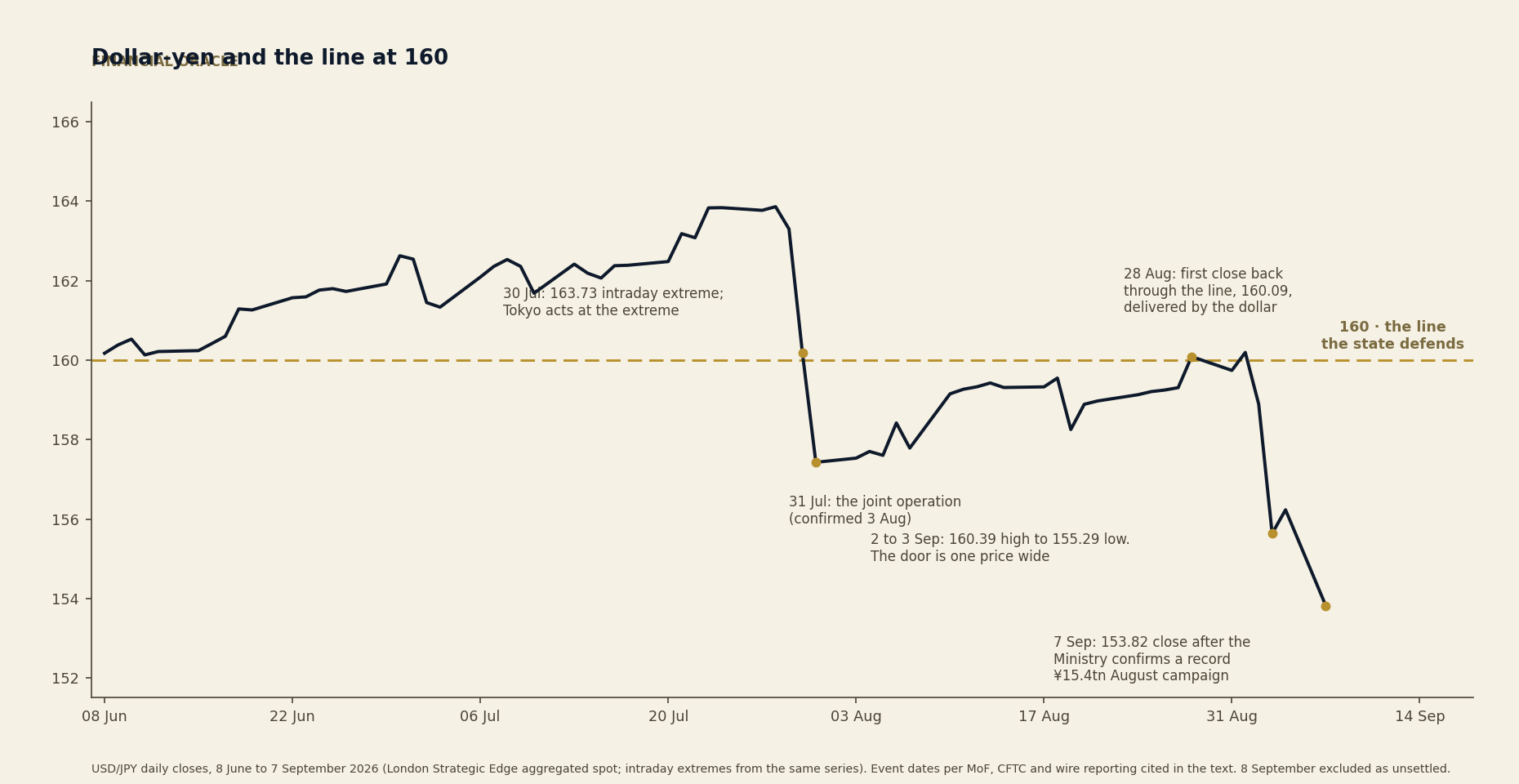
The rarer and heavier variant is joint intervention: two states acting together, each in its own market hours. Joint action is scarce because it requires the other side's consent to move its own currency, which is why the operation of 31 July 2026, conducted with the United States and confirmed on 3 August, mattered more than its size. It told the market that Washington, whose strong dollar was the other half of the problem, had agreed the move had gone far enough. The pair fell from near 163 toward 158 around those operations, and the 160 level it later stabilised beneath became the market's working definition of the line.
Lines, credibility and gap risk
A defended line is not a policy announcement; it is a market inference from where interventions have happened. That gives it a peculiar fragility: the line is credible only while it is unbroken, and every session that closes beyond it converts the defence from a wall into a question. On 28 August 2026 the dollar-yen pair recorded its first New York daily close back above 160 since the joint operation, delivered not by Tokyo's absence but by a hawkish repricing of the Federal Reserve that lifted the dollar against everything. That distinction matters: a line breached by the other currency's strength poses a harder problem than one breached by speculative attack, because the fix lies in fundamentals the defender does not control.
Positioning decides how violent the resolution is. Into that late-August breach, speculative accounts held a net short of 63,298 yen contracts, deepened through the preceding week (CFTC, as of 25 August, released 28 August), and by 1 September the short had been rebuilt to 92,227 contracts, its deepest since the joint-intervention week (CFTC, released 4 September). A crowded short pressed against a state's line is stored energy in both directions: if the line gives, the crowd wins slowly; if the state acts, or the fundamentals turn, the exit is a stampede through a door the size of one price. That asymmetry, a grind one way and a gap the other, is why the desk has carried the pair as a gap risk since June rather than a directional view. The first week of September demonstrated the mechanism: the pair traded 160.39 on 2 September and 155.30 a day later, five big figures inside two sessions, on Bank of Japan hike expectations, intervention wariness and haven flow, with the freshly rebuilt short caught in the door. The desk scored the move in July Never Happened. September Re-Arms. (7 September 2026).
When intervention works
The honest record is that intervention buys time, and time is only worth buying if something else changes. Operations conducted against the direction of interest rate differentials tend to fade: the carry that made the position attractive is still there the morning after, and the market re-accumulates it. Operations aligned with a turning fundamental stick, because the intervention becomes the punctuation of a story the market was starting to believe anyway. That is why the more consequential development of late August 2026 was not an operation at all: it was the US Treasury Secretary saying at the G20 that he expects Japanese policy to lead the yen higher (Reuters, 31 August 2026). A defender talking about rate policy is a defender conceding that the line needs fundamentals behind it, and an American official talking the other side of a crowded short is a new kind of participant in the defence.
How the desk uses it
The desk tracks the 160 line as the tell for one of its published scenario paths: the release valve on a regime in which every major central bank is constrained at once. A grind through the line on carry is one world; a gap through it on a shock is another, and the difference is readable in real time through positioning, the calendar and who is doing the talking. The line's first close-through since the joint operation was scored in The Chair Speaks. The Pen Stays. (31 August 2026), and the Treasury Secretary's remark was logged as a new sponsor of the move the crowd is short against in The Shock Writes. The Committee Waits. (1 September 2026). The mechanics of the trade on the other side of the line are the subject of the desk's companion piece on the carry trade, and the other visible state hand in markets this quarter, the US Treasury buying its own bonds, is explained in Treasury Buybacks and the Issuer's Hand.
Frequently asked questions
What is FX intervention in simple terms?
A government or central bank trading its own currency to move the exchange rate: selling foreign reserves to buy the home currency when defending it, or the reverse when weakening it. The point is rarely to overpower the market permanently; it is to change the risk of betting against the state.
Who intervenes in Japan, the Ministry of Finance or the Bank of Japan?
The Ministry of Finance holds the legal authority and makes the decision; the Bank of Japan executes the orders as the Ministry's agent. That split is why BoJ monetary policy and yen intervention can point in different directions at once, and why statements from the finance ministry, not the central bank, are the ones to watch for the line.
What was the joint US-Japan intervention of 2026?
An operation on 31 July 2026 in which both governments acted to support the yen, confirmed publicly on 3 August. Joint action is rare because it needs both sides to agree the move has gone too far; its significance is the agreement itself as much as the flows. The pair fell from near 163 toward 158 around the operations before settling near the 160 line. The Ministry's subsequent monthly release confirmed ¥15.4 trillion of intervention between 30 July and 26 August, the largest monthly intervention total on record.
Does FX intervention actually work?
It works as punctuation, not as plot. Operations against the pull of interest rate differentials tend to fade as carry rebuilds the position; operations aligned with turning fundamentals stick. Durable currency moves usually need fundamental reinforcement, which is why talk of rate policy from the defending side is often more consequential than the intervention itself.
Why does a crowded short make a defended line dangerous?
Because everyone on the wrong side of a state action tries to leave at once. A large speculative short pressed against a defended level converts any surprise, an operation, a policy shift, a shock, into a gap: the price does not travel through the levels in between, it jumps them. The more crowded the trade, the smaller the door.
| Free macro explainers, delivered in fullNew explainers reach the free list in full as they publish, with every research note's teaser alongside. Join the free list · inspect the scored record at /calls · the newest scored note is July Never Happened. September Re-Arms. |
This explainer is part of the FO Research library. The desk publishes its market reads before the print, dates them, and scores them against the tape afterwards. We read the data. We call the paths.

The research is Premium. The record is public.
Every Brief and Analysis in full: the scenario maps with explicit invalidation, the cross-asset tactical reads, the desk-formatted PDFs, and a scorecard where every call is dated before the print and scored after it, misses included. Inspect the record before you pay for it.
Subscribe to Premium →Not ready? Get the teasers by email, free · New to the mechanics? Learn is open to everyone.