Explainer
Treasury Buybacks and the Issuer's Hand
A Treasury buyback is the United States government repurchasing its own outstanding debt before it matures. The Treasury announces an operation, dealers offer bonds back, and the Federal Reserve Bank of New York, acting as Treasury's agent, accepts the offers it judges attractively priced and pays for them with Treasury's cash. It is a reverse auction: the world's largest borrower briefly turns around and becomes a buyer of its own paper. Buybacks were a footnote of debt management for two decades. In August 2026 they moved to the centre of the macro story, because the Treasury at least doubled the size of its long-end operations at the exact moment the long end of the curve was repricing the government's cost of borrowing.
What a buyback actually is
Mechanically, the process is simple. Treasury publishes a schedule naming which securities it will consider repurchasing, up to a maximum size per operation. Primary dealers submit offers: the bonds they hold, the prices they want. The New York Fed compares those offers against market pricing and accepts the ones that make sense, in a competitive, multiple-price process. Treasury pays, and the repurchased bonds are retired. The operation calendar, methodology and results are public on TreasuryDirect.
Two programmes run side by side. Cash management buybacks smooth the government's cash position around tax dates. Liquidity support buybacks, the ones that matter for markets, give dealers a standing opportunity to sell older, less liquid "off-the-run" bonds back to the issuer, freeing dealer balance sheets to make markets in everything else. The liquidity support programme has run since 2024, and Treasury's stated objectives for it, liquidity support and cash management, did not change. What changed in August 2026 was its size, and the signal the market took from it.
The August 2026 escalation
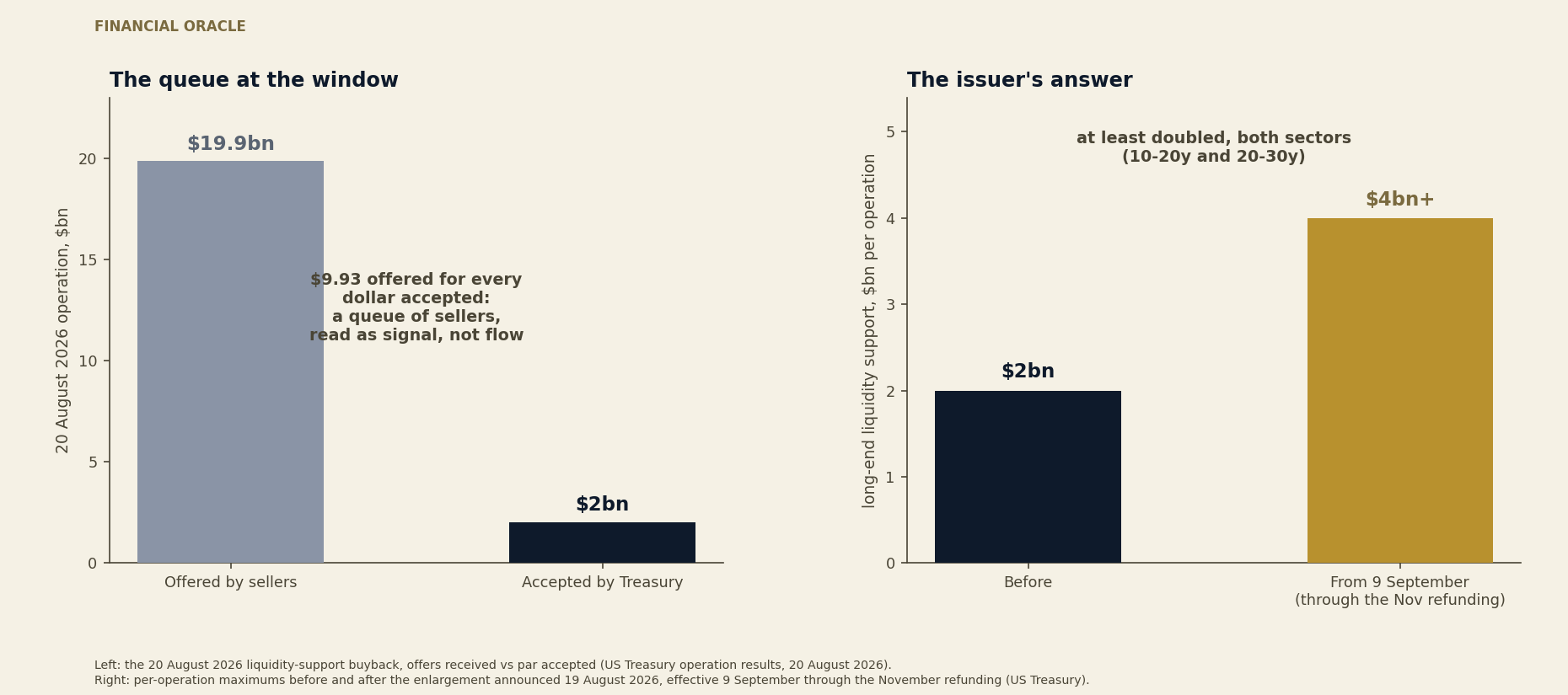
On 19 August 2026 the Treasury announced that its long-end liquidity support operations would at least double, from $2 billion to $4 billion or more per operation, across both the 10-to-20-year and 20-to-30-year sectors, effective 9 September and running through the November refunding (US Treasury, 19 August 2026). Thirty-year yields fell roughly nine basis points on the announcement alone. The Treasury Secretary then said the quiet part aloud: "We are going to make a market in these," adding the sizes could go higher still (CNBC, 20 August 2026). Days later came reports that the roughly $1 trillion cash balance in the Treasury General Account could fund the operations, and, via the financial press, that eliminating the 20-year bond entirely had been discussed (CNBC, 24 August 2026; Fox Business, 24 August 2026). Reports, not policy, and the desk labels them as such. But the direction of reach was public.
Why does this matter? Because if the enlarged purchases are ultimately financed with additional short-dated bills, the economic effect resembles a duration swap: long-dated bonds leave private hands while more short-dated paper arrives elsewhere in the funding programme. The conditional matters. Treasury does not formally match each buyback with new bills, its stated policy is that buybacks are not intended to alter the overall maturity profile of the debt, and the funding source for the enlarged operations was not specified at announcement; the reported candidates ran from the cash account to the bill programme. What changes either way is who must absorb the risk of holding long-term money at the margin, and the direction of the answer: less of it, the market. Applied at scale, that is a hand on the long end of the curve, applied by the borrower itself.
What a buyback is not
A buyback is not quantitative easing, and the distinction is the single most useful thing to understand about it. In QE the Federal Reserve pays for bonds by crediting reserve balances: central-bank money is created and the Fed's balance sheet expands. The Treasury cannot create reserves. It pays from cash it holds, accommodates the spending through its broader borrowing and cash-management programme, and the securities it buys back are retired. QE is a monetary operation. A buyback is a fiscal one. The market effect can rhyme, because both remove duration from private hands, but the buyer, the financing, the balance sheet and the constraint all differ. The Fed can print; the Treasury must fund.
That difference is also the limit. A buyback programme funded from a finite cash account, or from bill issuance the money markets must absorb, cannot expand indefinitely. It steadies a market. It does not repeal one.
How the desk reads it
The desk's framework, published as it happened, is that an issuer bidding for its own bonds changes what a price means. When the long end rallies on the issuer's own bid, with credit quiet and inflation expectations at highs, that rally is policy distortion, not price discovery: it tells you what the Treasury wants the price to be, not what the market believes. The desk registered that discipline in Ten Dollars Offered. One Accepted. (20 August 2026), written the week a buyback operation received $9.93 of offers for every dollar it accepted: a queue of sellers, read by the desk as signal rather than flow.
The same framework says what still testifies honestly when the long end is being steadied: the two-year, which the buybacks do not touch and which prices the committee, and gold, which prices the credibility of the whole arrangement. When the desk scored its Jackson Hole pre-registrations in The Chair Speaks. The Pen Stays. (31 August 2026), the issuer test was exactly this discipline, held and re-armed for the enlarged operations beginning 9 September.
Frequently asked questions
Is a Treasury buyback the same as QE?
No. QE is the central bank creating reserves to buy bonds, expanding its balance sheet. A buyback is the government using cash it holds or raises to repurchase and retire its own securities, with the financing managed through its wider borrowing programme; no central-bank money is created. Both remove duration from the market, which is why their price effects can look similar over short windows.
Do buybacks lower long-term yields?
The announcement effect is real: thirty-year yields fell around nine basis points when the doubling was announced on 19 August 2026, before a single enlarged operation had run. The durable effect depends on size against a market that trades hundreds of billions daily. The honest answer is that buybacks change the marginal buyer on the days they operate, and they change what a long-end rally means every day they exist.
Who sells bonds back to the Treasury?
Primary dealers, offering off-the-run securities from their own books or their clients'. The operation is voluntary and competitive: dealers offer, Treasury accepts what is priced attractively, and heavy offering relative to acceptance, like the 9.93-to-1 queue of August 2026, is itself information about how much paper wants out.
Why would the Treasury do this at all?
Officially: liquidity support and cash management, keeping the market for its own debt functioning smoothly. In August 2026 the timing of the expansion and the Secretary's own remarks led markets to read it more broadly, as an issuer leaning against a long-end repricing it did not accept, without asking the central bank for help. The desk's framework treats that reading as the one the tape now has to test.
What should I watch to judge whether it is working?
Three things. Whether long-end yields hold inside their range on operation days versus other days. Whether the two-year and gold confirm or contradict what the steadied long end appears to say. And whether the offered-to-accepted ratio in each operation rises or falls: a lengthening queue of sellers into a standing bid is the tell that the bid is load-bearing.
| Free macro explainers, delivered in fullNew explainers reach the free list in full as they publish, with every research note's teaser alongside. Join the free list · inspect the scored record at /calls · the newest scored note is The Chair Speaks. The Pen Stays. |
This explainer is part of the FO Research library. The desk publishes its market reads before the print, dates them, and scores them against the tape afterwards. We read the data. We call the paths.
The research is Premium. The record is public.
Every Brief and Analysis in full: the scenario maps with explicit invalidation, the cross-asset tactical reads, the desk-formatted PDFs, and a scorecard where every call is dated before the print and scored after it, misses included. Inspect the record before you pay for it.
Subscribe to Premium →Not ready? Get the teasers by email, free · New to the mechanics? Learn is open to everyone.