Explainer
How the Desk Scores Its Calls: the method behind the FO call record
The desk scores a published call by entering it at the close on or nearest its publish date, measuring it on one named price series, marking every row to a single as-of date and judging it against the base case as the note itself worded it. Most market commentary is never scored, because scoring it is where the difficulty lives. Each of those four steps is a place where method decides whether the figure can be trusted. This page sets out how the desk handles them, so the record can be checked rather than believed.
Why an unscored call is not a call
The gap between commentary and a forecast is falsifiability. "We are watching the long end closely" cannot be wrong. "The 30-year holds a 4.90 to 5.15 band through the print", published in The Floor Held. Again. on 10 June 2026, can be, at a stated level on a stated date. The desk publishes the second kind, which is why the record carries entries marked Missed. A scorecard with no losses is not a scorecard. It is a selection.
The record's newest entry shows the discipline applied in real time: the Jackson Hole pre-registration expected keynote continuity, the registered risk branch fired instead, and the scoring note published the miss first, at full weight (The Chair Speaks. The Pen Stays., 31 August 2026).
Two habits do the damage elsewhere. Retrospective framing describes a view after the move in language that happens to fit it. Silent abandonment lets a call that stopped working stop being mentioned. The defence against both is the same: date the claim, keep it in the table whatever it does and mark it on a schedule chosen before the outcome is known.
The five rules the record runs on
The entry is the publish date, not the best price. Entry is the close on or nearest the date the note went out, never the most favourable level reached in the days around it, and it is not adjusted afterwards. Where a note was written against a level that had already moved by publication, the row says so rather than quietly using the better number.
One named price basis per instrument, and no mixing. Brent alone can be quoted as spot, as the front-month future or as a broker's cash contract, and in June 2026 those three differed by more than five dollars on the same day. The 85.2 entry in The Buyers Go Home. on 16 June could not be reproduced on spot at 80.5 or the front month at 79.0, and was reconciled only once the measurement matched the cash feed the note was written against. Until then the row carried no peak figure and said why. An entry measured on one series and an outcome on another gives a number that is not so much wrong as meaningless.
Results and peaks share one as-of date. Every open row is marked to the same date, currently 28 August 2026, stated at the top of the table. A record that marks its winners to today and its losers to an older, kinder date is measuring two things in one column. The peak column carries the other half, showing the best level each call reached over the same window, so a call that ran and then reversed shows both at once. It appears on every row, winners and losers alike, so the measure reads the same everywhere.
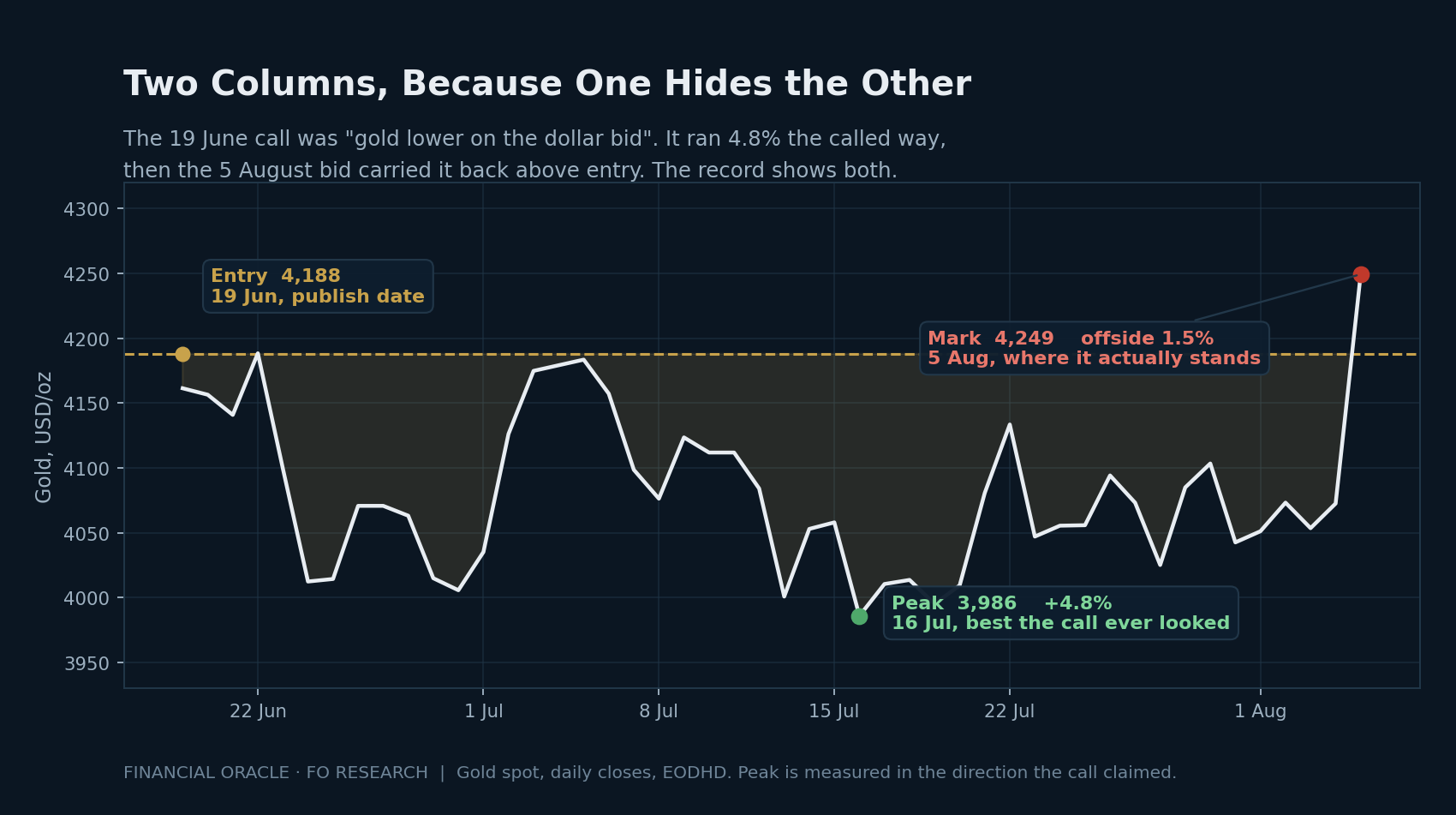
Peaks are measured in the direction the call claimed. This is the rule most easily broken by accident. Where Held Out for the IPOs argued on 9 June that the Nasdaq grinds 5 to 10% lower, the favourable excursion is the distance it fell, not the distance it rose. Applying it consistently in August 2026 corrected five rows measured against their own claim, three of which then read better and two worse, and left three reading "none" where a call never traded favourable at all. Excursions use daily closes rather than intraday extremes, which differ between feeds and cannot be reproduced by a reader.
The verdict is scored against the note's own words. Each row is judged on the base case as stated, not a direction inferred later. When Six Pillars said on 1 June the front end "stays in the high-3s" and the 2-year never returned below 4%, that is a miss whatever else the note got right. Held means the claim is true at the mark. Target reached and surpassed means a stated level was met and exceeded. Partial covers a call half right, or right and then materially reversed. Rotated means a later note superseded it. Missed means the claim is false at the mark.
The line between Partial and Missed is drawn on the mark rather than the story, so it reads identically on every row. Missed means the claim is false at the mark and was never delivered on the way to it. Partial means half of a compound claim held, or the move the call named was delivered and then given back. Partial sits inside the headline measure and is identified separately, so the full distribution is published alongside the headline and readers can apply a narrower definition if they prefer.
What the headline number counts
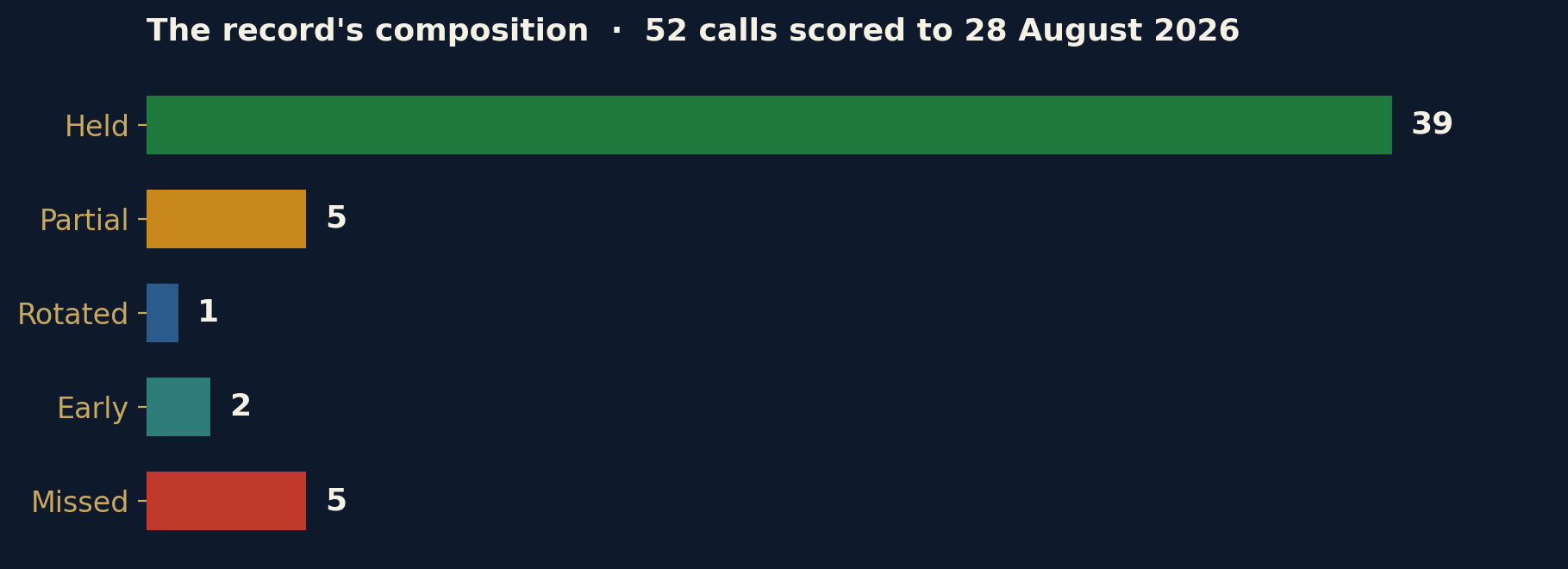
The headline figure is held or better, and at the 28 August 2026 mark it stands at 87%. It counts held, partial and rotated outcomes against the full set of 52 scored calls, misses included in the denominator. A reader is entitled to know how broad that is, which is why the composition sits beside it rather than behind it.
The distribution is 39 held, 5 partial, 1 rotated, 2 marked early and 5 missed. A partial is not counted as a win in disguise: it is identified separately inside the broad measure, as is the single rotation, so readers who prefer a stricter definition can exclude either. The two early rows remain unresolved: they contribute to the full 52-call denominator but not to the held-or-better numerator. Held alone is 39 of 52; the broad measure is 87%. Both read from the same table.
What matters more than which figure is printed is that the definitions do not move. What matters more than which figure is printed is that the definitions do not move. Keeping the methodology fixed allows changes in the record to reflect the calls themselves rather than changes in measurement.
What the record cannot tell you
The record scores forward guidance, not trade entries. It carries no position sizing, entry timing, stops or risk limits, so no reader's outcome can be inferred from it. A directionally correct call held through a drawdown that would have closed a levered position is still marked held, which is a real gap between a research record and a return.
It is also a young record measured across one regime, and a method that reads one configuration well can read the next one badly. Sample size is a limit no measurement discipline fixes.
And the marks are consistent rather than artificially precise. Feeds differ, entries are rounded to the levels published in the notes, and an as-of date is a snapshot of an open position, not a settled result. The components-over-headline discipline the desk applies in Term Premium, Explained applies to its own scorecard: the summary figure moves, the composition decides. The rows marked Open are open, and they can still go wrong. All of them are dated, quoted and scored in the call record.
Frequently asked questions
How does Financial Oracle score its own calls?
Every call is entered at the close on or nearest its publish date, measured on a single named price series per instrument and marked to a common as-of date shown at the top of the record. Verdicts are judged against the base case as the note stated it, and the record retains calls that missed alongside those that held.
What is peak excursion and why show it on losing calls?
Peak excursion is the best level a call reached between publication and the as-of date. It is shown on every row, including losers, because a call that ran a long way before reversing and one that never worked at all are different failures, and a peak column shown only on winners is marketing rather than disclosure.
What does "held or better" actually count?
Held, partial and rotated outcomes measured against the full set of scored calls, misses included in the denominator. It is a broad test, so the record publishes the distribution alongside it. At the 28 August 2026 mark that was 39 held, 5 partial, 1 rotated, 2 early and 5 missed, letting a reader apply a stricter test from the same numbers.
What does it mean that a call is marked Rotated?
That a later note superseded it on the same instrument, usually because the desk's read changed as conditions did. Rotated calls stay in the table with their original entry so a changed view is visible as a change, though it does mean the tape never settled the original call.
Does a strong research track record mean an investor would have made money?
No. The record scores published forward guidance, not trades. It contains no sizing, timing, stops or risk limits, and a call marked held may have moved far enough against the view first to close a levered position. It measures research quality, not realised return.
The 87% is not the reason to trust the research. That any reader can inspect exactly how it is produced is.
| Free macro explainers, delivered in fullNew explainers reach the free list in full as they publish, with every research note's teaser alongside. Join the free list · inspect the scored record at /calls · the newest scored note is The Chair Speaks. The Pen Stays. |
This explainer is part of the FO Research library. The desk publishes its market reads before the print, dates them, and scores them against the tape afterwards. We read the data. We call the paths.


The research is Premium. The record is public.
Every Brief and Analysis in full: the scenario maps with explicit invalidation, the cross-asset tactical reads, the desk-formatted PDFs, and a scorecard where every call is dated before the print and scored after it, misses included. Inspect the record before you pay for it.
Subscribe to Premium →Not ready? Get the teasers by email, free · New to the mechanics? Learn is open to everyone.