Explainer
Term Premium, Explained: Why Long Yields Rise as the Fed Cuts
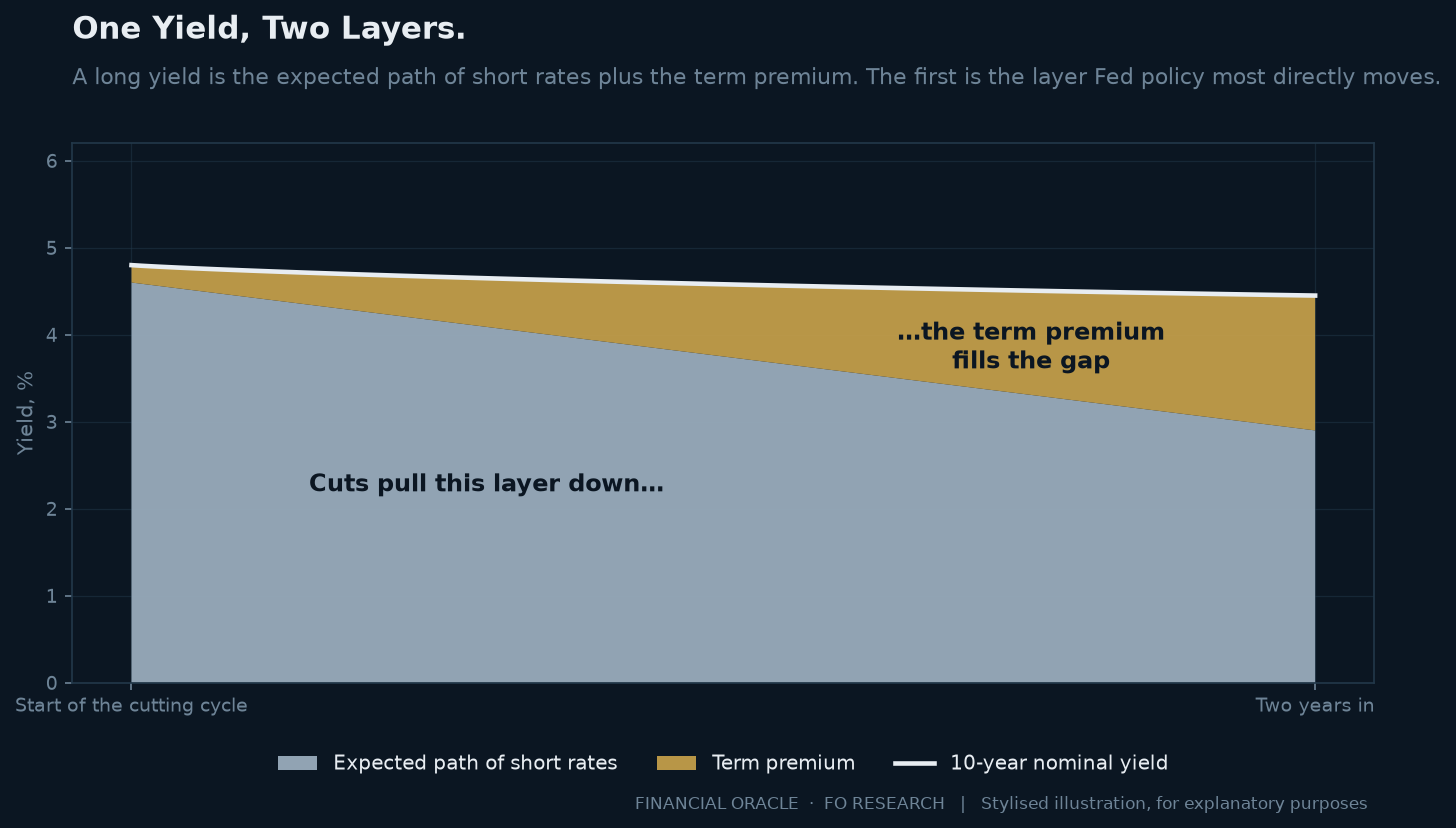
The term premium is the extra yield investors demand for holding a long-dated bond instead of rolling short-dated ones. A 10-year yield is two things stacked together: the market's expected average of short rates over the decade, plus this premium for bearing the risk that the expectation proves wrong. The Fed steers the first layer far more directly than the second. That is why long yields can rise while the Fed cuts, and it is the single most misread mechanic in the bond market.
One yield, two layers
Take a 10-year Treasury yielding 4.5%. Roughly speaking, that number decomposes into the average short rate the market expects the Fed to deliver over ten years, and a residual: the term premium. If the expected path averages 3.5%, the premium is a full point. The first layer is a forecast. The second is a price of risk: compensation for locking money into duration, the sensitivity of a bond's price to moves in yields, when inflation, policy and supply can all work against you over a decade.
The distinction matters because the two layers answer to different masters. The expected path answers to the Fed, the data and the dots. The term premium answers to uncertainty, to the supply of bonds that must be absorbed, and to the willingness of the buyer base to absorb them. A cut usually lowers the near-term expected path, to the extent it was not already priced and does not push longer-run expectations the other way. What it does to the second layer depends entirely on why the cut is happening and who is left to buy the duration.
You cannot observe it, only estimate it
The term premium is not printed on any screen. It is inferred, most commonly from models such as the New York Fed's ACM estimates, which attempt to strip the expected-rate path out of the observed curve. The estimates disagree with each other and are revised, which is worth remembering whenever a precise figure is quoted. The desk treats the level as soft and the direction as informative. When several major estimates rise together, confidence grows that a genuine repricing of risk is under way, even if no single number deserves worship. The premium can also be negative, when demand for duration is unusually strong or when long bonds carry significant hedging value against riskier assets.
What makes the term premium rise
Three forces do most of the work.
Uncertainty about inflation and policy. A market that trusts the central bank to deliver 2% inflation needs little compensation for holding duration. A market staring at a hot services pipeline while cuts are delivered into it needs more. The desk's read of that configuration is laid out in A Pipeline, Not a Spike.
Supply and the buyer base. Duration has to be absorbed by someone. When deficits run at wartime scale in peacetime and the traditional price-insensitive buyers, foreign reserve managers, banks and the central bank itself, are stepping back, the marginal buyer must be paid more to take the risk. The desk has tracked that thinning bid in The Buyers Go Home.
The information regime. Forward guidance was, in effect, a term-premium suppressant: fifteen years of the Fed telling markets what came next made duration feel safe. Withdraw the guidance and the premium may need to be rebuilt. That is the mechanism the desk named in The Silence Premium: less information from the Fed does not lower the floor under long rates, it prices a new premium into it.
One nuance on the current cycle: the repricing appears to have been driven more by fiscal, supply and real-rate risk than by any clear de-anchoring of long-run inflation expectations. The textbook mechanism and the desk's read of this regime are not identical, and the distinction is worth keeping.
Why long yields rise when the Fed cuts
Put the layers together and the puzzle dissolves. A cutting cycle drags the expected-path layer lower. But if the cuts are being delivered into sticky inflation, heavy issuance and a thinning buyer base, the term premium rises at the same time, and it can rise by more than the expectations layer falls. The observed long yield, the sum of the two, goes up. The Fed is easing and the long end is tightening. Nothing is broken. The composition has changed.
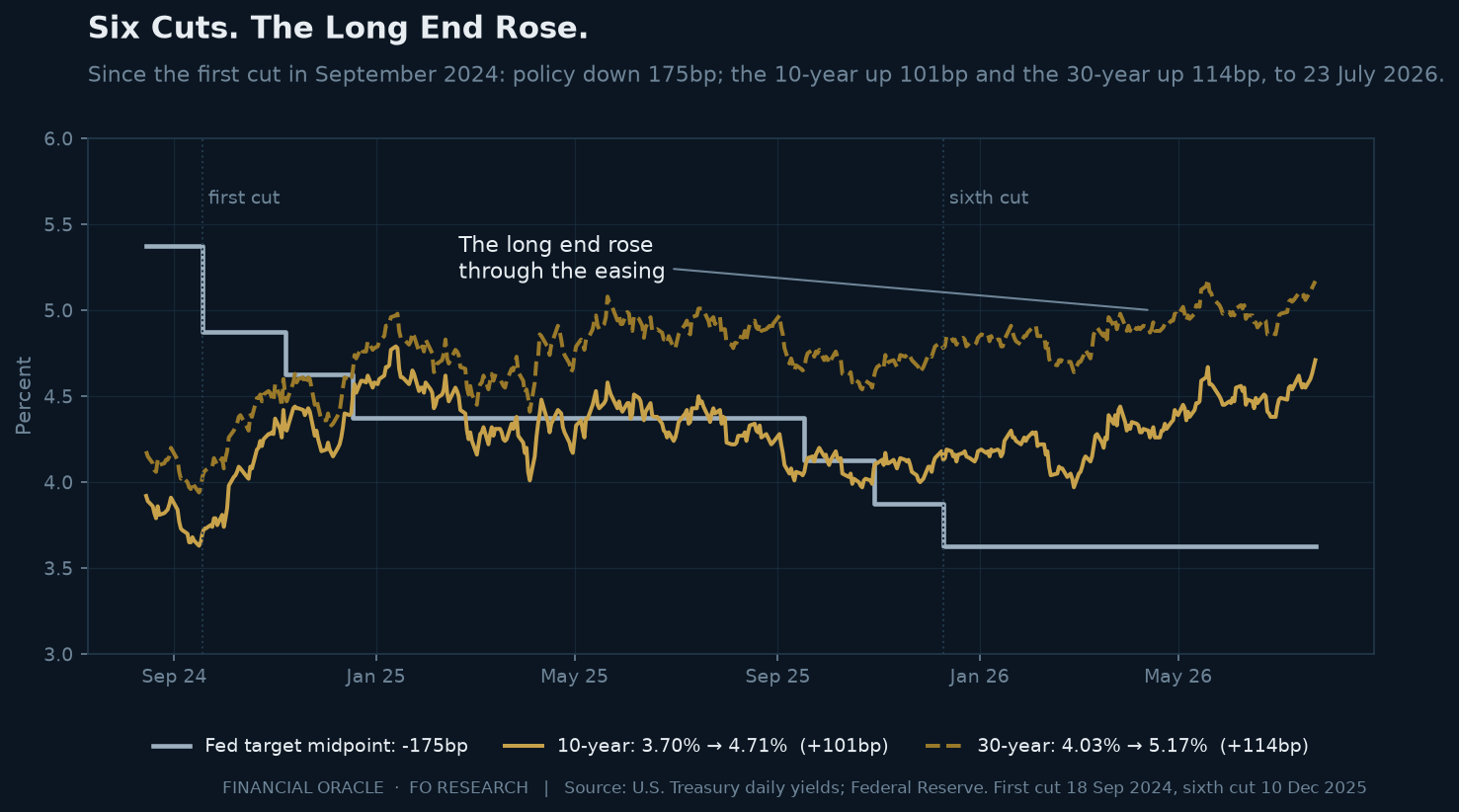
The recent cycle is an unusually clean demonstration. Between the first cut on 18 September 2024 and the sixth on 10 December 2025, the Fed lowered its target range by 175 basis points. Over the same window the 10-year Treasury yield rose from 3.70% to 4.13% and the 30-year rose from 4.03% to 4.78%. And the move did not stop there: as of 23 July 2026 the 10-year stood at 4.71% and the 30-year at 5.17%, roughly 101 and 114 basis points above their first-cut levels, against a policy rate 175 basis points lower. The policy rate fell. The long end repriced inflation, supply, uncertainty and duration risk on its own terms. Nothing is broken. The composition has changed. The desk's dated reads of that episode run through The Long-Bond Disconnect. It is not a level. It is a regime: the floor under long rates that the desk has tracked all year is, in large part, a term-premium floor.
Reading it in practice
The desk watches four things. Long-dated auctions first: the tail, when a sale clears at a higher yield than the market indicated just beforehand, and the bid-to-cover, the demand received relative to the amount sold, because the premium is ultimately set where duration meets its marginal buyer. The ACM-family estimates, for direction rather than level. The deficit path and the pace of quantitative tightening, because both set how much duration must be absorbed. And the Fed's communication regime itself, because guidance can suppress the premium and renewed uncertainty can rebuild it. None of these is a timing tool. Together they say whether the compensation for duration is being repriced, which is the slow-moving force underneath everything else in the bond market. The desk's dated rates calls, including the ones that missed, are scored in the track record.
For the cross-asset read-through, the term premium is one half of the composition question that runs through the desk's work: the same nominal move means opposite things depending on whether real yields or inflation expectations drive it, a distinction unpacked in Gold vs Real Yields.
Frequently asked questions
What is the term premium in simple terms?
It is the extra yield you are paid for holding a long bond instead of rolling short ones: compensation for the risk that inflation, policy or supply move against you over the bond's life. A long yield is the expected path of short rates plus this premium.
Why does the term premium rise when the Fed cuts rates?
It does not have to. But it can rise when cuts occur alongside persistent inflation uncertainty, heavy bond issuance, reduced balance-sheet support or weaker demand from traditional buyers. The cuts lower the expected-rate layer while the risk layer reprices higher, so the observed long yield can rise even as policy eases.
Can you observe the term premium directly?
No. It is estimated by models, most prominently the New York Fed's ACM estimates, which infer it by stripping the expected rate path out of the curve. Estimates differ and are revised, so the direction of change is more informative than any precise level.
Why are 10-year yields not falling even though the Fed is cutting?
The Fed sets the overnight rate directly and strongly influences expected short rates. It can also influence the term premium, through its balance sheet, its communication and its credibility, but it does not control it. In the recent cycle, 175 basis points of cuts between September 2024 and December 2025 were met by a 10-year that rose from 3.70% to 4.13% and a 30-year that rose from 4.03% to 4.78%: a move consistent with a rising term premium more than offsetting the decline in the expected-rate component.
What does a rising term premium mean for investors?
It means investors require more compensation for holding duration. It often appears as long-end-led curve steepening, and it raises the discount rate applied to long-duration assets, including equities. It can coexist with recession concern, so the desk does not treat it as a standalone timing or directional signal.
This explainer is part of the FO Research library. The desk publishes its market reads before the print, dates them, and scores them against the tape afterwards. We read the data. We call the paths.
The research is Premium. The record is public.
Every Brief and Analysis in full: the scenario maps with explicit invalidation, the cross-asset tactical reads, the desk-formatted PDFs, and a scorecard where every call is dated before the print and scored after it, misses included. Inspect the record before you pay for it.
Subscribe to Premium →Not ready? Get the teasers by email, free · New to the mechanics? Learn is open to everyone.