Explainer
Quant vs Discretionary Macro: Why the Desk Runs Both
Systematic macro trades rules; discretionary macro trades judgement. A quantitative strategy encodes its views in models and executes them with machine discipline. A discretionary desk reads data, policy and narrative, and sizes its view by hand. Each approach fails in its own characteristic way, and those failure modes often differ. That is the case for running them together, and it is how the desk is built.
What systematic macro actually is
A systematic, or quantitative, macro strategy is a set of rules applied without exception. The rules map observable inputs into positions across markets: prices, yields, growth and inflation data, positioning. Once the rules are set, the machine does the work: it can watch hundreds of series at once, it never tires, and it executes the same way on a calm Tuesday as it does mid-panic.
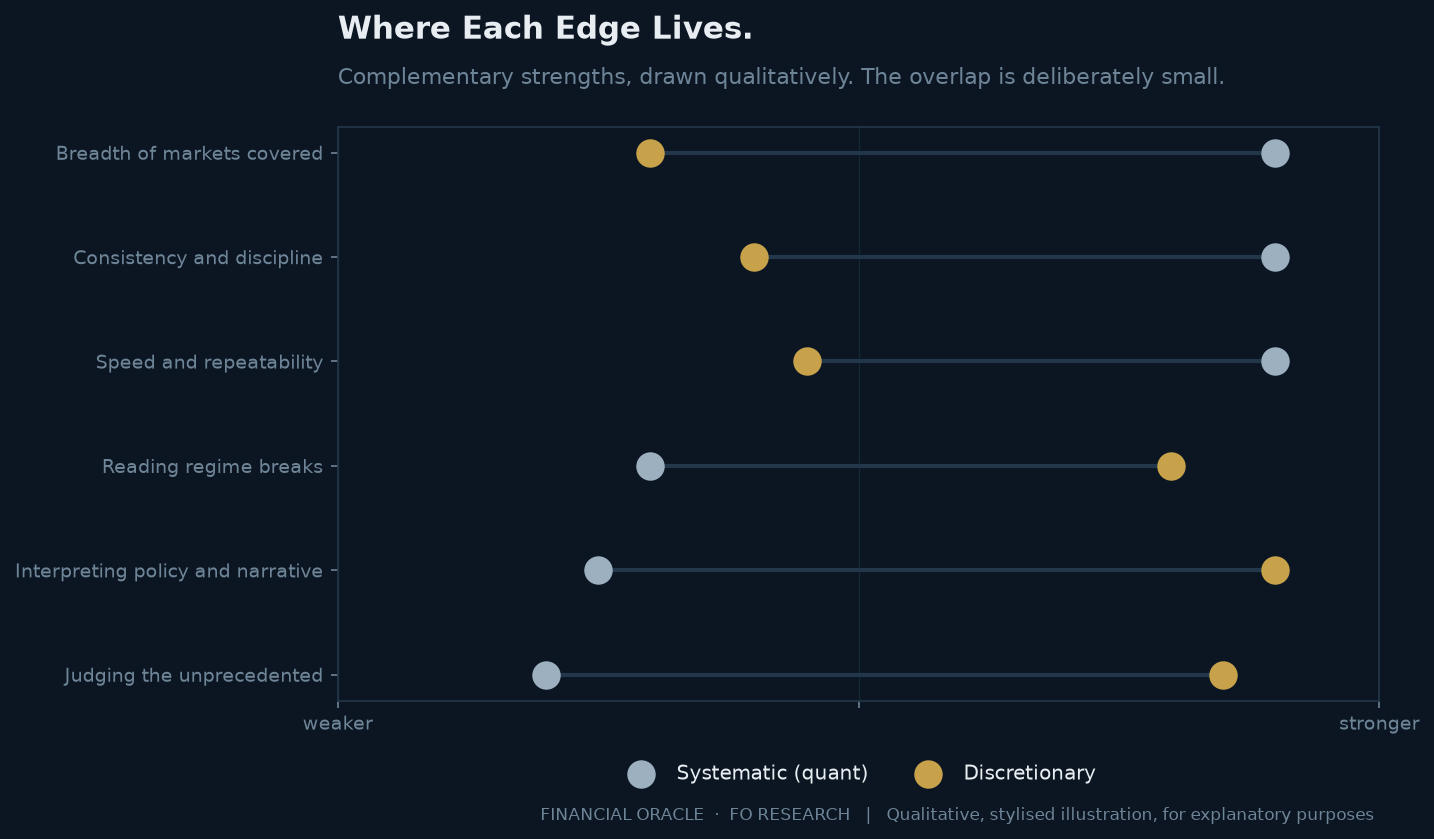
Its strengths follow directly. Breadth, because code scales where attention does not. Consistency, because a model applies its logic identically every time. And discipline, because a model does not get attached to a losing view, does not revenge-trade and does not need the market to validate its ego. Over long horizons, harvesting many small edges across many markets with machine patience is a genuine and durable source of return.
Its characteristic failure is the regime break. A model is a compressed memory of history: it knows the world it was fitted to. When the structure of that world changes, a new policy regime, a new marginal buyer, a cartel that stops behaving like a cartel, the model keeps trading yesterday's world until the data forces it to relearn. It is rarely wrong quietly. It is wrong systematically, at size, in exactly the moments when history stops rhyming.
What discretionary macro actually is
A discretionary macro trader builds a view the way an analyst builds an argument: from data, from policy reaction functions, from flows and positioning, from history and from judgement about what is genuinely new. The view is expressed in a small number of concentrated positions, and the trader decides when the facts have changed.
Its strengths are the mirror image of the machine's. A practitioner can price what has no precedent: a new Fed chair with a different reaction function, a war premium, a reserve manager changing behaviour for political rather than financial reasons. A practitioner reads meaning, not just values, in a statement's changed wording. And a practitioner can act on a thesis before it exists in any dataset.
The failure modes are equally human. Emotion: fear cuts winners early and hope runs losers long. Narrative capture: a compelling story defends itself against disconfirming data. Inconsistency: the same evidence read differently on different days. And capacity: a human mind holds a dozen live ideas, not a thousand series. Discretion concentrates both insight and error.
The honest comparison
Which is better? The honest answer is that the question is badly posed. The two styles earn their returns from different sources and fail in different states of the world. Systematic strategies can compound relatively steadily while market relationships stay compatible with their design, and give some of that back when regimes turn. Discretionary strategies live and die on the quality of a handful of judgements, which makes the dispersion between good and bad practitioners far wider than any average gap between the styles. Neither is a caricature either: modern systematic books model regime change too, and both styles can lose money in the same shock. Neither dominates across all regimes, and the desk treats claims to the contrary, in either direction, as marketing.
Why the desk runs both
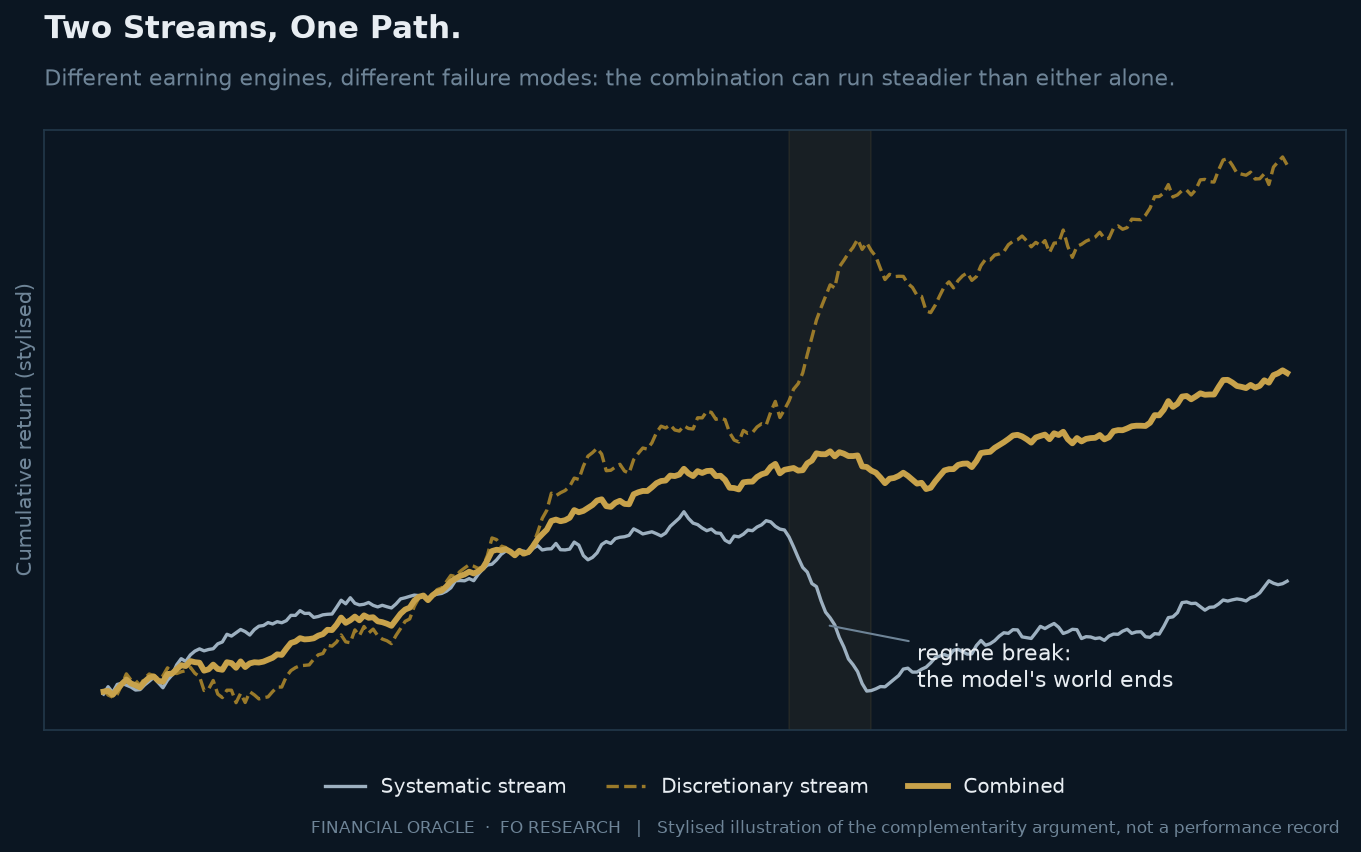
The complementarity is the argument. Two return streams that earn differently and fail differently may, in combination, produce a steadier path than either alone. The stronger form of the argument, though, is not diversification arithmetic. It is division of labour.
The machine does what machines do best: breadth, vigilance, discipline, the patient harvesting of structural tendencies across markets. The practitioner covers the ground where experienced judgement adds the most value: deciding when the model's world has ended. A regime call, that guidance is being withdrawn, that the marginal buyer of Treasuries has changed, that an energy shock has become a refining shock, is precisely where experienced judgement may identify a structural change before it is fully reflected in the model's inputs. In the desk's design, the algorithmic core handles breadth, vigilance and repeatability, while discretionary macro positioning addresses regime shifts, concentrated opportunities and risks outside the model's horizon. Both operate within a common portfolio-level risk budget.
It is not automation with a human fallback. It is not intuition with a spreadsheet. It is two different instruments for reading the same market, each covering the other's blind spot.
How this shows up at Financial Oracle
Financial Oracle runs a proprietary algorithmic core executed alongside discretionary macro positioning calibrated by experienced practitioners, across FX, commodities, indices and US equities. The specific rules, signals and sizing are proprietary and stay that way. What is public is the judgement layer: the desk publishes its discretionary reads before the print, dates them and scores them against the tape afterwards, including the misses, in the track record. The regime frameworks that guide the calibration, most recently the six-pillar regime map, are published in full. The infrastructure behind the core is described on the technology page.
Frequently asked questions
What is systematic (quant) macro?
A strategy that encodes macro views into explicit rules and models, mapping data such as prices, yields, growth and positioning into positions across many markets, executed systematically according to predefined rules. In a hybrid portfolio a separate discretionary layer may adjust aggregate exposure alongside the model without hand-editing each signal. Its edge is breadth, consistency and discipline.
What is discretionary global macro?
A strategy in which practitioners form macro views from data, policy analysis and judgement, and express them in concentrated positions they size and exit by hand. Its edge is interpreting regime change, policy and events that have no historical precedent.
Which performs better, quant or discretionary macro?
Neither dominates across all regimes. Systematic strategies tend to do well while markets resemble their training history and struggle at regime breaks; discretionary results depend heavily on the individual practitioner, so dispersion within the style is wide. The two fail in different conditions, which is why many allocators want both.
Why do funds combine systematic and discretionary approaches?
Because their principal failure modes often differ. The model supplies breadth, vigilance and discipline; the practitioner supplies regime judgement and the decision that a model's world has changed. Two return streams that earn and fail differently can combine into a steadier path than either alone.
How do global macro hedge funds make money?
By taking positions in rates, currencies, commodities and equity indices that express views on macro forces: growth, inflation, policy and flows. Returns come from forecasting those forces better than the market prices them, and from bearing macro risk in a disciplined, risk-managed way across many partly independent trades.
This explainer is part of the FO Research library. The desk publishes its market reads before the print, dates them, and scores them against the tape afterwards. We read the data. We call the paths.
The research is Premium. The record is public.
Every Brief and Analysis in full: the scenario maps with explicit invalidation, the cross-asset tactical reads, the desk-formatted PDFs, and a scorecard where every call is dated before the print and scored after it, misses included. Inspect the record before you pay for it.
Subscribe to Premium →Not ready? Get the teasers by email, free · New to the mechanics? Learn is open to everyone.