Explainer
Payrolls Revisions and the Benchmark
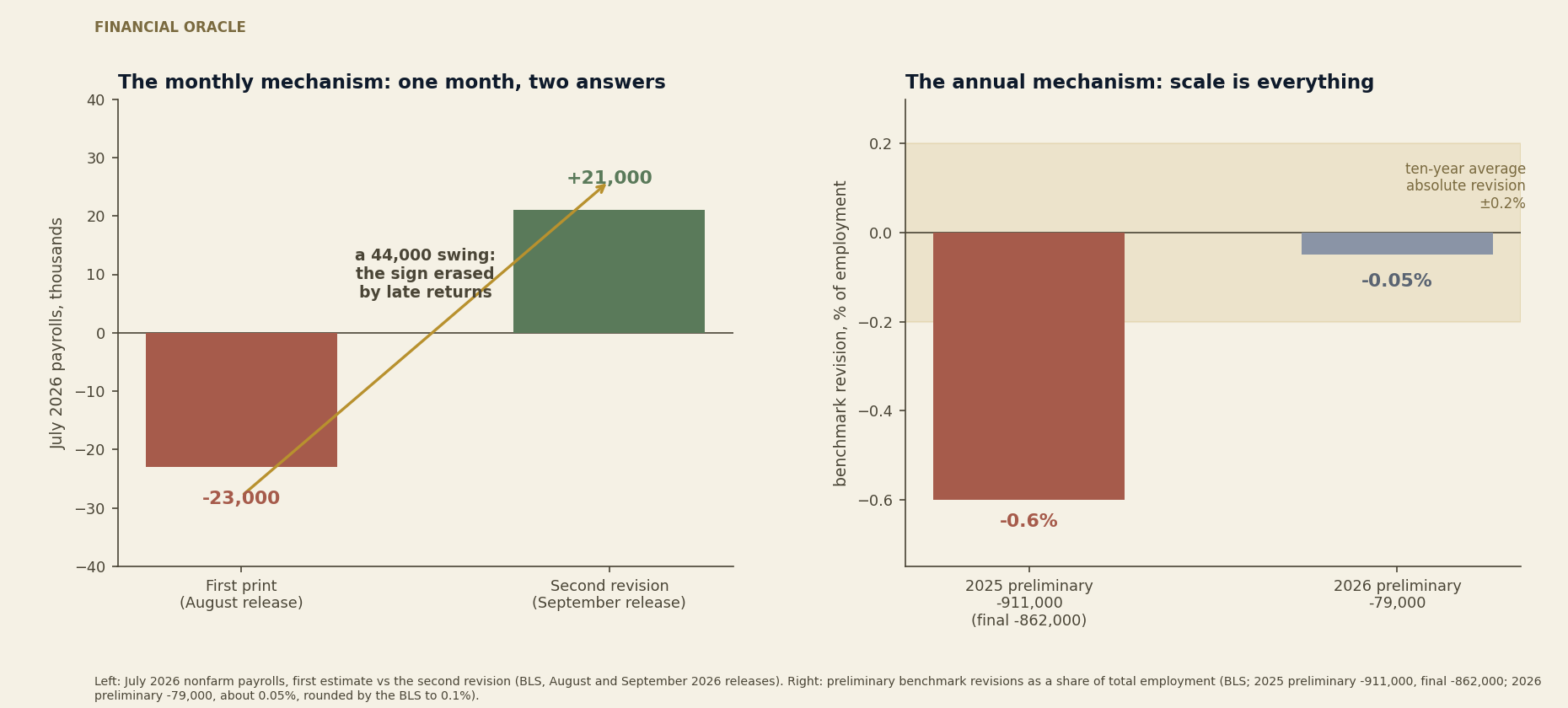
US payrolls numbers are revised because the headline figure is an estimate published fast, from a survey, and the truth arrives slowly, from tax records. Each monthly jobs number is revised twice in the following two reports as late survey responses arrive. Then, once a year, the Bureau of Labor Statistics re-anchors the entire level of employment to near-census payroll tax data, in what is called the benchmark revision. The preliminary benchmark lands in late summer, the final one the following February. In 2025 the preliminary benchmark subtracted 911,000 jobs from the count. In August 2026 the same exercise subtracted 79,000, against a consensus that had looked for an upward revision near plus 183,000 (Bloomberg, 28 August 2026). A week later the monthly mechanism produced a demonstration of its own: July 2026's first print of minus 23,000 was revised to plus 21,000 in the September report, erasing the sign entirely (BLS, 4 September 2026). Understanding what these numbers are, and are not, is the difference between reading the labour market and being whipsawed by it.
Why the numbers move after publication
The monthly payrolls figure comes from the Current Employment Statistics survey: a large sample of businesses, but a sample. Responses trickle in after the deadline, so the first print is built on incomplete returns and gets revised in each of the next two reports as the stragglers arrive. Those routine monthly revisions carry signal of their own. When late respondents report systematically different employment changes from early respondents, revisions can cluster in one direction, and a persistent run of downward revisions can become a labour market data point in its own right.
The benchmark is a different animal. Nearly every employer files unemployment-insurance tax records, and once a year the BLS reconciles its survey-based level against that near-census source. The gap between the two is published as the benchmark revision: first as a preliminary estimate, then folded into the official history with the January report, published in February. Between those dates, nothing mechanical changes: the monthly prints keep publishing off the old base. What changes is what everyone knows about the level the next prints stand on.
How to read a benchmark print
Three disciplines keep the reading honest. First, scale it: the 2025 preliminary benchmark of minus 911,000 was 0.6% of total employment against a ten-year average absolute benchmark revision of 0.2%, and the final figure was subsequently reduced to minus 862,000; research from within the Federal Reserve system found no statistical evidence of a structural break in the process. The 2026 preliminary of minus 79,000 was about 0.05% of total employment, a figure the BLS itself rounds to 0.1%: within the normal noise of reconciling a survey to a census. Second, date it: a preliminary benchmark re-levels the year through the previous March, so it describes where employment was, not where it is going. Third, watch what the market does with it rather than what the headline says. When the 2026 print landed on 28 August, it arrived in the same hour as the Fed chair's first Jackson Hole address, and the session traded entirely on the speech: a small revision, as the desk had registered in advance, disarmed the event.
The reflex read is the trap. Weak labour data equals lower yields is the oldest rule in macro, and in an inflationary regime it fails at the long end. A softening labour market alongside elevated inflation expectations can produce a very different rates response from the textbook weak data, lower yields trade: the front end prices the central bank's dilemma while the long end prices the inflation. The August 2026 tape showed the distinction, when weak retail sales initially pulled front-end yields lower before the rally faded as oil and inflation risk reasserted themselves, leaving the long end higher and the curve steeper.
How the desk uses revisions
The desk treats revision events the way it treats every scheduled print: registered in advance, scored after. Before the 2026 preliminary benchmark, the desk published its threshold in Three Hands. One Pen. (25 August 2026): a downward revision beyond roughly 300,000 would re-level the labour market the Fed chair was speaking over, while anything smaller would disarm the event and leave the keynote alone on the stage. The print came in at minus 79,000, the small-revision branch fired exactly as registered, and the desk scored the test as a hit in The Chair Speaks. The Pen Stays. (31 August 2026). The registration is the method: decide what a number would mean before it exists, in public, so the reading cannot be retrofitted to the outcome.
That discipline was tested within days of this piece being drafted. The August 2026 report printed 162,000 against a consensus near 56,000, and the number that mattered more sat underneath: July's minus 23,000, the anchor of a month of labour-weakness argument, was revised to plus 21,000. The revision did not adjust a story, it deleted one. The desk's own scenario work had leaned on the negative print, scored the lean as a miss in public and logged the test it had registered on July's sign as voided by revision, in July Never Happened. September Re-Arms. (7 September 2026), and September rate pricing re-armed the same session. The lesson is this piece's entire argument: the revision history, not the headline, decided how that Friday read.
Frequently asked questions
Why does the BLS revise payrolls numbers?
Because the first estimate is published about three weeks after the survey week, before all businesses have responded. The two monthly revisions incorporate late returns; the annual benchmark reconciles the survey level to near-census tax records. Speed first, accuracy later, with the trade-off disclosed on a published schedule.
What is the payrolls benchmark revision?
The annual re-anchoring of the employment level to unemployment-insurance tax records, which nearly all employers must file. A preliminary estimate lands in late summer covering the year through March; the final figure is incorporated in the February jobs report. It corrects the level of employment, not the month-to-month changes.
Was the 911,000 downward revision evidence the data was manipulated?
No. A large benchmark revision is not, by itself, evidence of manipulation. The benchmark process exists specifically to identify drift between the survey estimates and the more comprehensive tax-record count, and analysis within the Federal Reserve system, run across samples back to 1980, found no statistical evidence of a structural break in how the estimates are built. The correction was published, on schedule, by the same agency that produced the original estimate.
Do revisions mean the jobs data is unreliable?
They mean the first print is a fast estimate with known error bands. The discipline is to treat every headline as provisional, watch the direction of revisions as its own signal and anchor on the trend across multiple reports rather than any single number. Markets that trade the first print as final are taking a position on data the publisher itself has promised to change.
Why was July 2026's negative jobs number revised away?
Because the first estimate is built on incomplete survey returns, and the late responses changed the sum: July moved from minus 23,000 to plus 21,000, a 44,000 swing, with the two-month net revision worth plus 55,000 (BLS, 4 September 2026). Nothing unusual happened. A first print near zero can change sign on routine late returns, which is exactly why the desk treats every headline as provisional until the revision cycle has spoken.
What happens to the -79,000 in February 2027?
The final benchmark, which can differ from the preliminary, will be folded into the official employment history with the January jobs report published in February. Until then the monthly prints stand on the old base, and the preliminary figure serves as the market's best estimate of how far that base is off.
| Free macro explainers, delivered in fullNew explainers reach the free list in full as they publish, with every research note's teaser alongside. Join the free list · inspect the scored record at /calls · the newest scored note is July Never Happened. September Re-Arms. |
This explainer is part of the FO Research library. The desk publishes its market reads before the print, dates them, and scores them against the tape afterwards. We read the data. We call the paths.



The research is Premium. The record is public.
Every Brief and Analysis in full: the scenario maps with explicit invalidation, the cross-asset tactical reads, the desk-formatted PDFs, and a scorecard where every call is dated before the print and scored after it, misses included. Inspect the record before you pay for it.
Subscribe to Premium →Not ready? Get the teasers by email, free · New to the mechanics? Learn is open to everyone.