Explainer
The Carry Trade Explained: Mechanics, Risk and the Yen Unwind
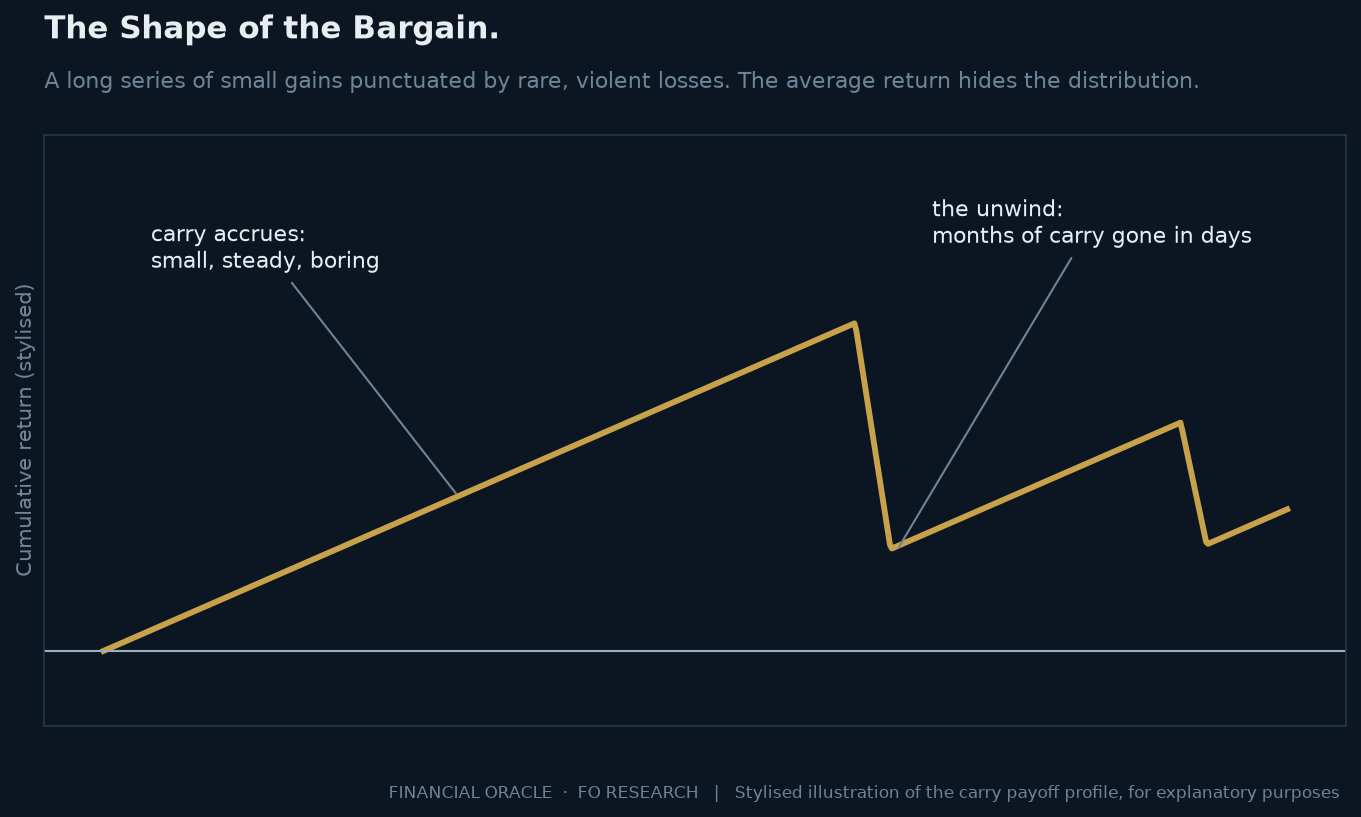
A carry trade borrows in a currency where money is cheap and holds one where it pays more, keeping the difference. The interest differential accrues quietly, day after day, and the position makes money for as long as the exchange rate does not move against it. That is the bargain: a small, steady, predictable income in exchange for an occasional, sudden, large loss. The trade is not mispriced so much as differently shaped, and understanding the shape is the whole point.
The mechanics
Take the textbook version. Borrow yen at a low policy rate, sell the yen for dollars, and hold the dollars in an instrument paying the higher US rate. Each day, the position earns roughly the gap between the two rates, and unwinds cleanly if the exchange rate is unchanged. The yen is the funding currency, the dollar the target currency, and the gap between them is the carry.
The same structure appears well beyond currencies: borrowing short to hold long-dated bonds is a carry trade on the yield curve, and selling volatility is a carry trade on insurance premiums. All of them share the same profile: paid a little to wait, exposed to a lot if the thing you are short suddenly reprices.
Under uncovered interest parity, this should not produce a persistent excess return. A higher-yielding currency ought, on average, to depreciate by roughly the interest differential, cancelling the gain. In practice that relationship has often failed for long stretches, which is why the carry trade persists as one of the oldest and most crowded expressions in global macro. The desk's view is that the persistent excess return is not free money: it is compensation for bearing a specific, real and occasionally brutal risk.
The shape of the bargain
Carry returns are famously described as picking up pennies in front of a steamroller. The phrase is glib but the distribution is real: long runs of small positive returns, punctuated by rare drawdowns that erase months or years of accumulated carry in days.
This matters because it defeats the ordinary statistics. A carry strategy measured over a calm period looks like a high-quality return stream: steady, low volatility, attractive on a naive risk-adjusted basis. The measured volatility is low precisely because the risk has not shown up yet. When it does, it arrives as a single move larger than anything in the sample that preceded it. Judging carry by its recent Sharpe ratio is therefore close to judging an insurance company by the years in which nothing burned down.
Why unwinds are so violent
Three features turn a crowded carry trade into a disorderly one.
Leverage. The interest differential is usually a few percentage points at most, so participants lever the position to make it worth doing. Leverage means small adverse moves force position reduction rather than patient waiting.
Crowding. Everyone identifies the same funding currency and many of the same targets, so the exit is through the same door. When the move starts, participants simultaneously sell target assets and buy back the funding currency, overwhelming available liquidity and accelerating the adjustment.
Reflexivity. Closing the trade means buying back the funding currency, which pushes the funding currency higher, which worsens the loss for everyone still in the trade, which forces more closing. The unwind is self-feeding for as long as the positioning lasts. This is why carry unwinds are measured in days rather than quarters, and why they often coincide with volatility spikes far larger than the underlying macro news seems to warrant.
The yen, the classic case
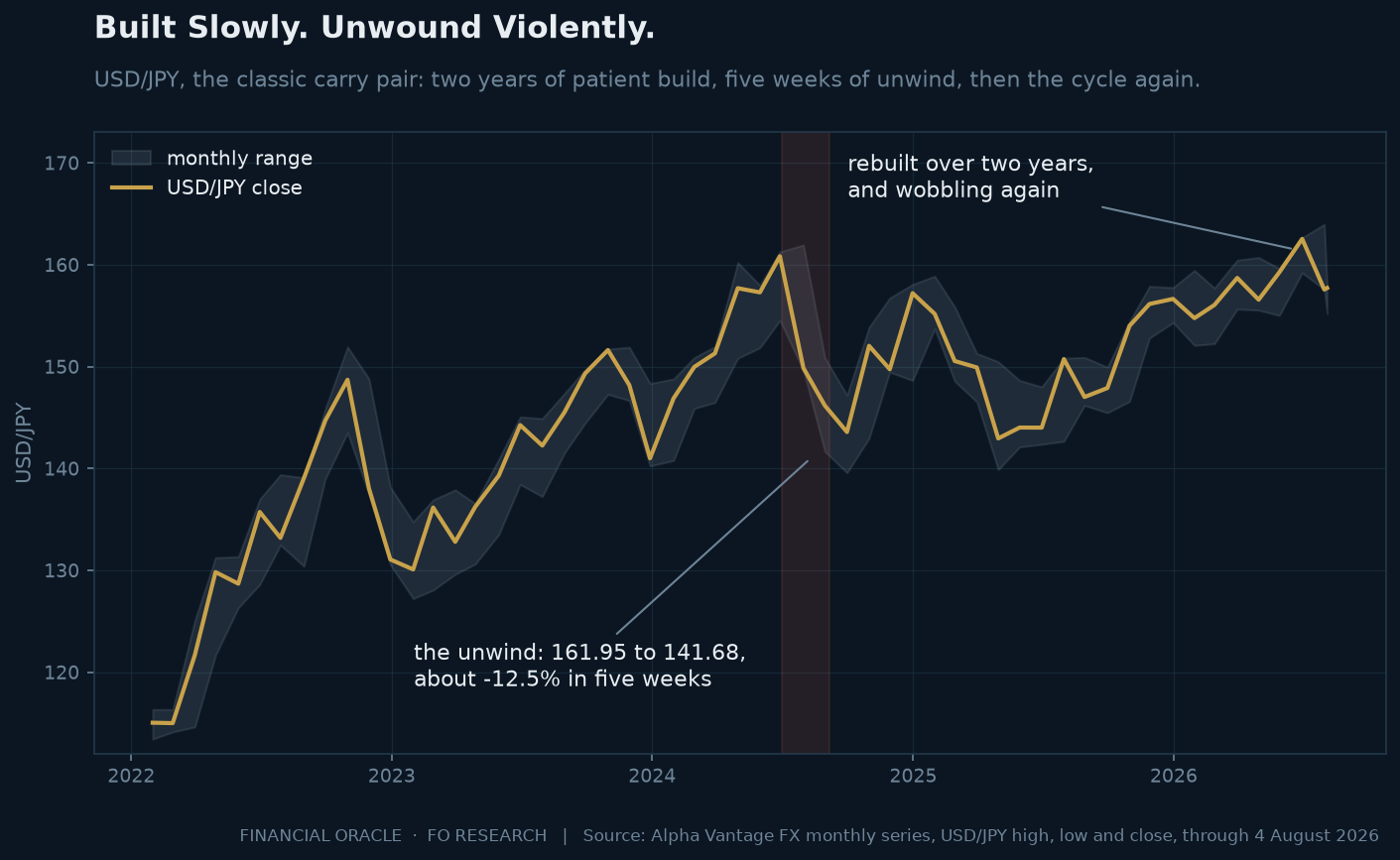
USD/JPY is the canonical carry pair, and the recent record shows the full cycle.
Through 2022 the trade was built aggressively as the Federal Reserve raised rates while the Bank of Japan held: USD/JPY rose from roughly 115 at the end of February 2022 to a high near 152 that October, about 32%. The build continued into 2024, and the pair reached an intramonth high of 161.95 in July 2024.
Then it broke. Within about five weeks, USD/JPY fell to an intramonth low of 141.68 in August 2024, a decline of roughly 12.5%. Nothing in the macro data moved 12% in five weeks. The initial catalysts were a hawkish Bank of Japan rate increase, a reassessment of the US policy outlook after weaker labour data, and a narrowing expected rate differential. But positioning determined the scale: leverage, margin pressure and forced yen buying turned the initial adjustment into a disorderly unwind.
The sequel is instructive. The trade rebuilt. Over the following two years USD/JPY climbed back, reaching an intramonth high of 163.98 in July 2026, above its pre-unwind peak, before easing to around 157.7 by 4 August 2026, with an intramonth low of 155.21. Carry trades are not destroyed by their unwinds; they are interrupted by them. The differential re-attracts capital, positioning rebuilds, and the same vulnerability reassembles.
How the desk reads it
Carry is a positioning trade, so the desk reads positioning rather than the differential alone. Three inputs carry most of the information: the rate differential and, more importantly, its expected direction, because unwinds tend to begin when the market starts pricing the gap to narrow rather than when it actually narrows; volatility, because low volatility makes leverage feel safe while rising volatility forces de-risking; and crowding, visible imperfectly through futures positioning data, because the severity of an unwind depends partly on how many participants share the same exposure.
None of this is a timing tool. A crowded carry trade can stay crowded for years, which is exactly why the trade pays. The desk's use of it is as a fragility indicator: when the differential is narrowing, volatility is rising and positioning is extreme at the same time, the distribution of outcomes has changed even if nothing has happened yet. The dollar leg of that read sits in The Dollar, Decoded, and the rate leg in r-star Explained; the desk's dated positioning calls are scored in the track record.
Frequently asked questions
How does a carry trade work?
You borrow in a currency with a low interest rate, convert the proceeds into a currency with a higher interest rate, and hold an instrument earning that higher rate. The daily gain is roughly the interest differential, and the position is profitable as long as the exchange rate does not move enough against you to erase it.
What is a funding currency?
The low-yielding currency you borrow to finance the trade. The yen and the Swiss franc have historically been the classic funding currencies because their policy rates sat far below those of the target currencies.
What caused the yen carry trade unwind in 2024?
A hawkish Bank of Japan rate increase, a reassessment of the US policy outlook after weaker labour data and a narrowing expected rate differential began the exit from a crowded, heavily levered position. Closing the trade means buying back yen, which pushed the yen higher and forced further closing. USD/JPY fell from an intramonth high of 161.95 in July 2024 to a low of 141.68 in August 2024, about 12.5%.
What are the risks of a carry trade?
Principally exchange-rate risk amplified by leverage and crowding. The return profile is many small gains and occasional large losses, so measured volatility understates true risk during calm periods. A sudden move in the funding currency can erase months of accumulated carry within days.
Could the yen carry trade unwind again?
The structural conditions can rebuild whenever a wide rate differential, low volatility and crowded positioning coincide, and USD/JPY did recover to an intramonth high of 163.98 in July 2026, above its pre-unwind peak. The desk treats that combination as a fragility signal rather than a timing signal: it changes the distribution of outcomes without dating the event.
This explainer is part of the FO Research library. The desk publishes its market reads before the print, dates them, and scores them against the tape afterwards. We read the data. We call the paths.

The research is Premium. The record is public.
Every Brief and Analysis in full: the scenario maps with explicit invalidation, the cross-asset tactical reads, the desk-formatted PDFs, and a scorecard where every call is dated before the print and scored after it, misses included. Inspect the record before you pay for it.
Subscribe to Premium →Not ready? Get the teasers by email, free · New to the mechanics? Learn is open to everyone.