Is this a regulated fund offering?
No. FO Research is a publication. It does not constitute an offer to sell or a solicitation of an offer to buy any security or fund interest. References to Financial Oracle SPC are for context, not solicitation.
How does FO Research differ from a trading-signals service?
FO Research is structural macro research, not a signals feed. The reasoning, scenario design and invalidation criteria travel through every report: the framework behind the view, not a screen of entry and exit prompts. We publish reasoning, not tips.
What does Premium cost?
$49 per month, or $490 per year (a 17% saving on annual). Charged in USD via Stripe. Premium unlocks every publication in full: the FO Briefs, every FO Analysis Report with its archive grade PDF, the FO Market Breakdown, scenario maps with explicit triggers and invalidation criteria, pair by pair FX tactical reads (EUR, GBP, JPY, AUD, CAD, CHF), full archive access and the daily Market Regime page. The record every call is scored against is public at /calls before you pay.
What is free, and what is Premium?
Open to everyone: the economic calendar schedule with actuals coloured against consensus, the central bank tracker, FO News Live headlines with filters across the full history, the positioning heatmap, the headline regime call, every Learn explainer, the opening of every Brief and Analysis Report and the scored record. Free membership needs only your email, no card, and adds the full FO News Live view with asset tags that track each market for 4 hours after an alert, the FO view on each calendar release with the market move after headline releases, the full positioning check for every market, surprise alerts by email and each note’s teaser by email as it ships. Premium, at $49 a month or $490 a year, adds every Brief and Analysis Report in full with its PDF, the FO Market Breakdown, the scenario maps and invalidation criteria, the full archive and the daily Market Regime page.
What does my free email unlock?
Without an account, FO News Live shows each alert’s headline and the first line of what it means, and the positioning page shows the heatmap with each market’s reading. Join free with your email and you see everything: the FO view, the full analysis, the key facts and the briefings in full on FO News Live, with asset tags that show how each market has moved since the alert on a 4 hour sparkline; the FO view on every calendar release, and on headline releases the move in the main currency and index since the release; and the full positioning check for every market, with net contracts, weekly changes, share of open interest, z-scores and the trader groups. Prices on the tags are live for the major currency pairs, gold, silver, oil, the US stock index futures, the main government bond yields and the dollar index; a few other markets are delayed by about 10 to 15 minutes and marked “(delayed)”. No card required.
What is FO News Live?
The desk’s live feed at /live/: market alerts as the data lands, the pre-London and pre-New York briefings, and the FO view on what each move means. It updates through the trading day, with the day’s key releases in a strip along the top, actuals coloured against consensus. Anyone can filter the feed by type, asset, FO view, country and impact across everything published; free members also see asset tags that track each market for 4 hours after an alert.
What is the positioning page?
One page built on the CFTC’s weekly Commitments of Traders report, at /positioning/. A colour-coded heatmap at the top shows where large speculators sit in each currency, rates, equity index and commodity futures market against 20 years of weekly reports, and how that changed on the week. Click or tap a market to open its full check: the trader groups in two sets, the main CFTC split (large speculators, commercials and small traders) and funds detail (leveraged funds and asset managers, from a separate CFTC report), with the 6 month to 5 year windows and the raw data. It updates after each Friday release. It describes positioning only and is not a recommendation.
What is the central bank tracker?
Part of the calendar at /calendar/#central-banks, open to everyone: the next policy meeting, the current rate and the latest scheduled appearances for the nine central banks the calendar covers, with market-implied odds of a hold, hike or cut at each bank’s next meeting, taken from prediction market pricing and refreshed hourly. These are market prices, not an FO Research forecast. The PBoC has no such market, so it shows n/a.
What are FO Research Alerts?
A separate email list for surprise alerts: an email when a high impact release lands well outside forecasts, at most three a day. It is on by default for new members, and you can switch it off in your account without leaving the research emails.
What is the Market Regime page?
A Premium page at /regime/, updated daily. It reads growth, inflation, policy and financial conditions into one headline regime call with its confidence and duration, then shows the drivers with live figures, a financial conditions gauge, how assets typically behaved in past episodes of the regime since 2007, what would flip it, what changed this week, a week-ahead risk map with central bank meeting odds, an economic surprise index for the G10 and the major regions, and CFTC positioning measured against the regime. The headline call and the four pillar readings are open to everyone. It describes conditions; it is not a forecast or a recommendation.
Is there an economic calendar?
Yes, at /calendar/: the high impact events that move markets, across the US, euro area, UK, Japan, Canada, Australia, New Zealand, Switzerland and China, for this week and next, with optional filters to add medium and low impact releases and central bank speeches, and the central bank tracker on the same page. Every time is shown in your own time zone, and official actuals are published as they are released, green above consensus and red below. The schedule, with the previous, consensus and actual figures, is open to everyone. Free with your email, each release also carries the FO view on why it matters now, what an upside or downside surprise means for currencies, yields and stocks, and, once it is out, which way it surprised and by how much, with a link to the FO News Live read. On headline releases, tags show how the main currency and index moved in the hour or four hours after, with a "Usually up" or "Usually down" note where past releases give a clear guide.
Is there a Telegram channel?
Yes, and it is live and free. The FO Telegram channel carries every FO News Live alert and briefing as it breaks, straight to your phone. Join @FONewsLive.
Which time zone are times shown in?
FO News Live, the economic calendar and the central bank tracker show each time once, in your device’s own time zone by default, with a short label such as 17:30 Dubai or 09:30 New York. You can switch to Dubai, London, New York, Singapore, Hong Kong, Tokyo, Sydney, Frankfurt, GMT or any other time zone, or back to your local time; the choice carries across the pages, including the times inside alerts and briefings, and daylight saving is handled automatically.
How do Briefs work?
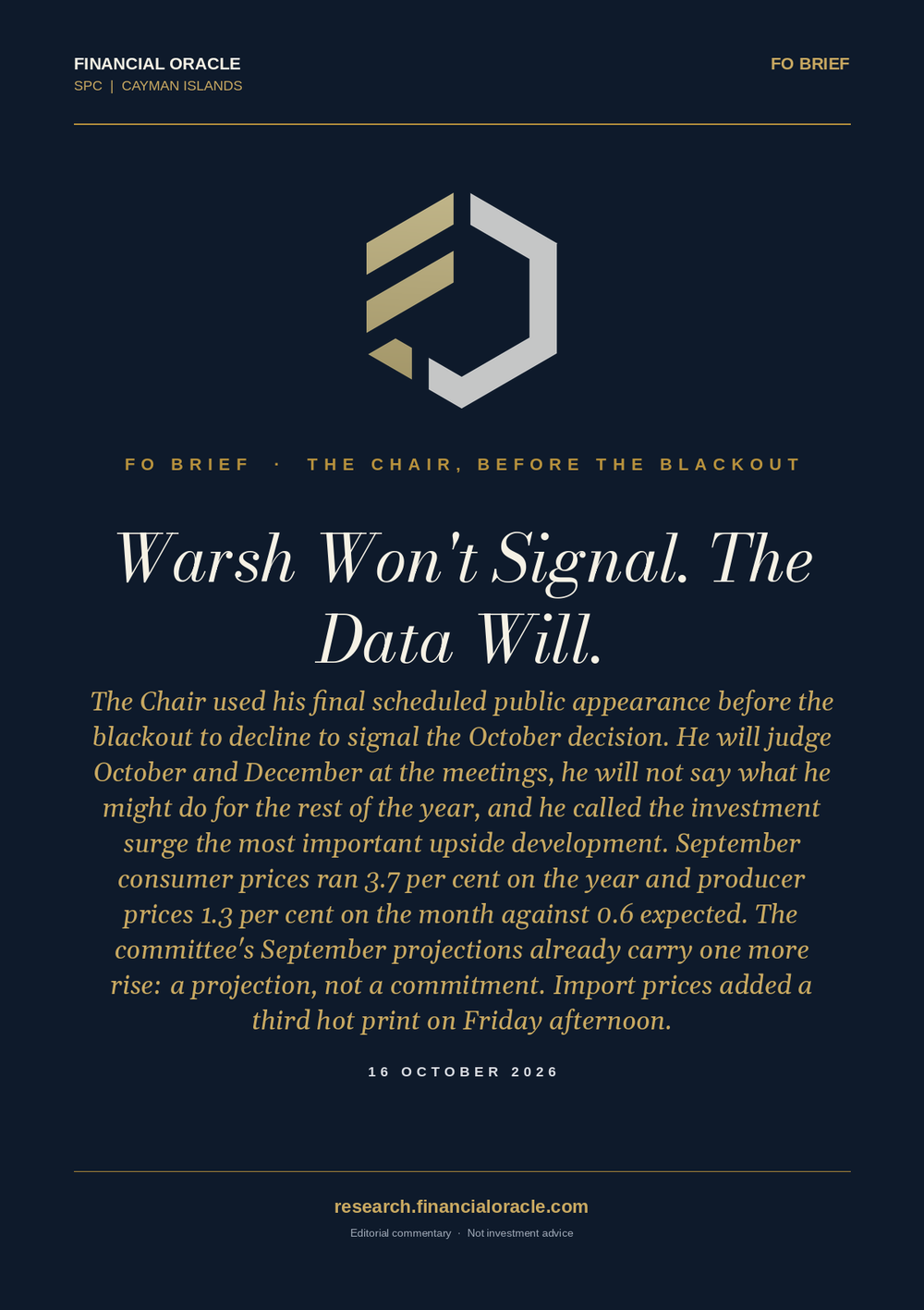
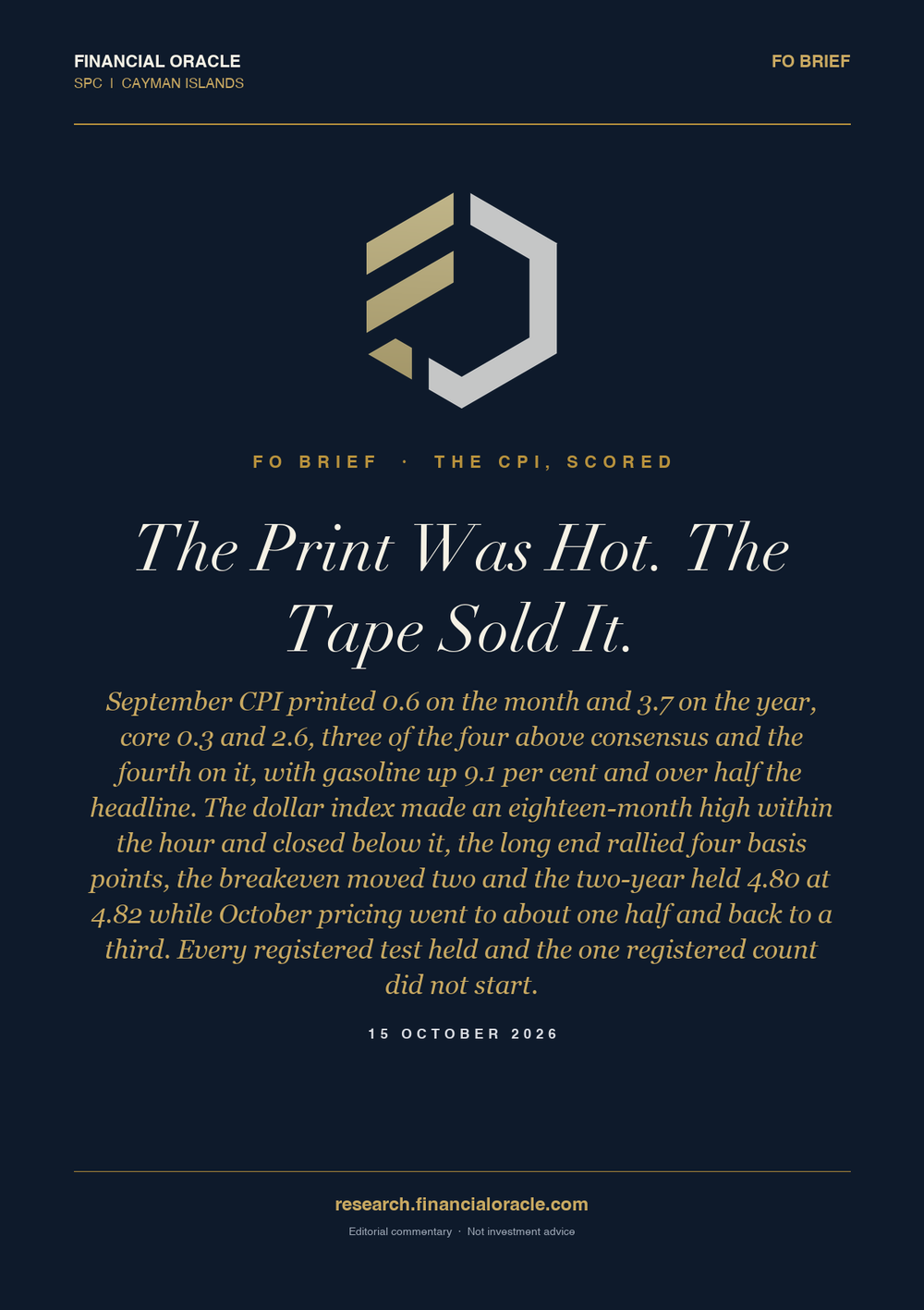
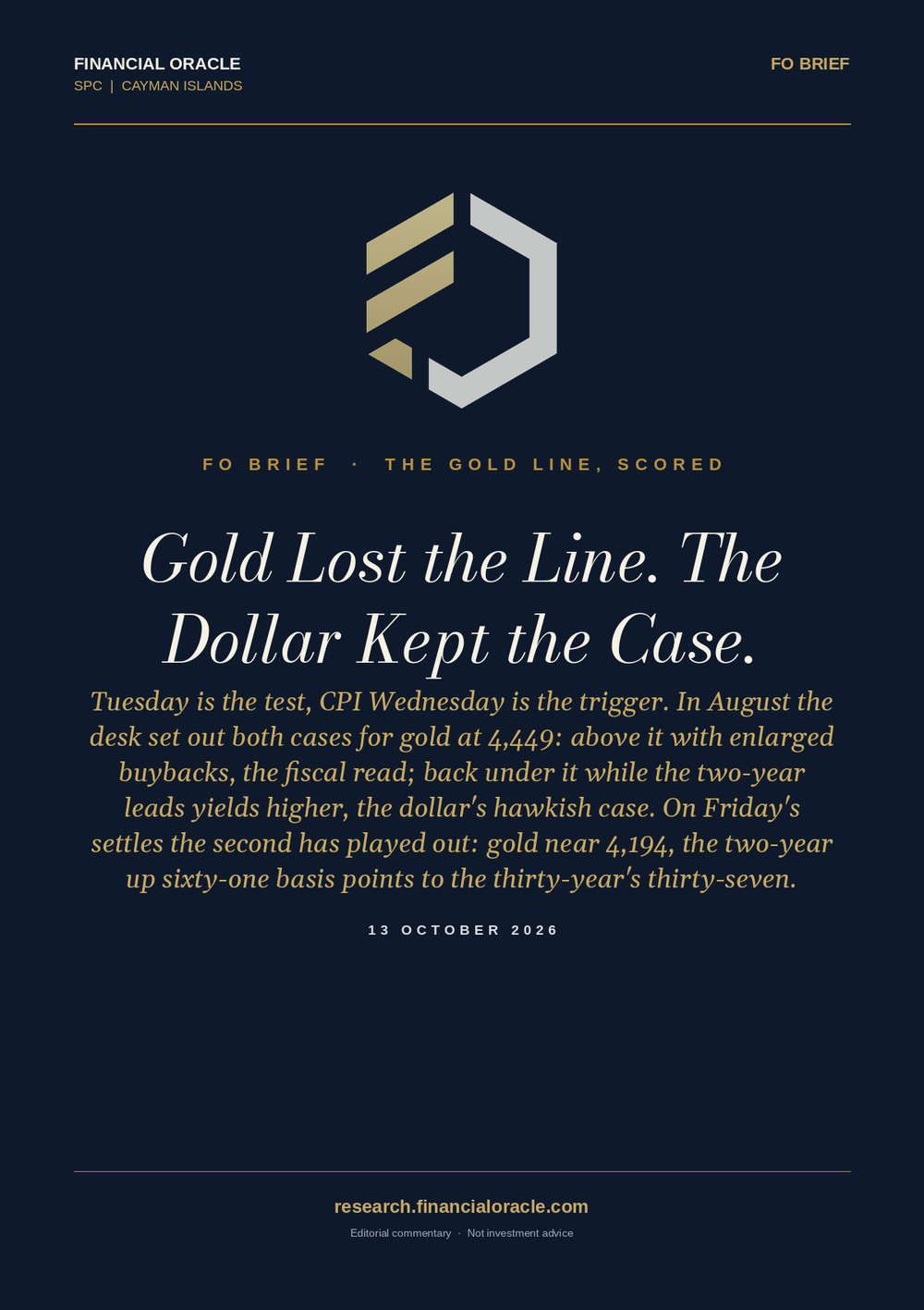
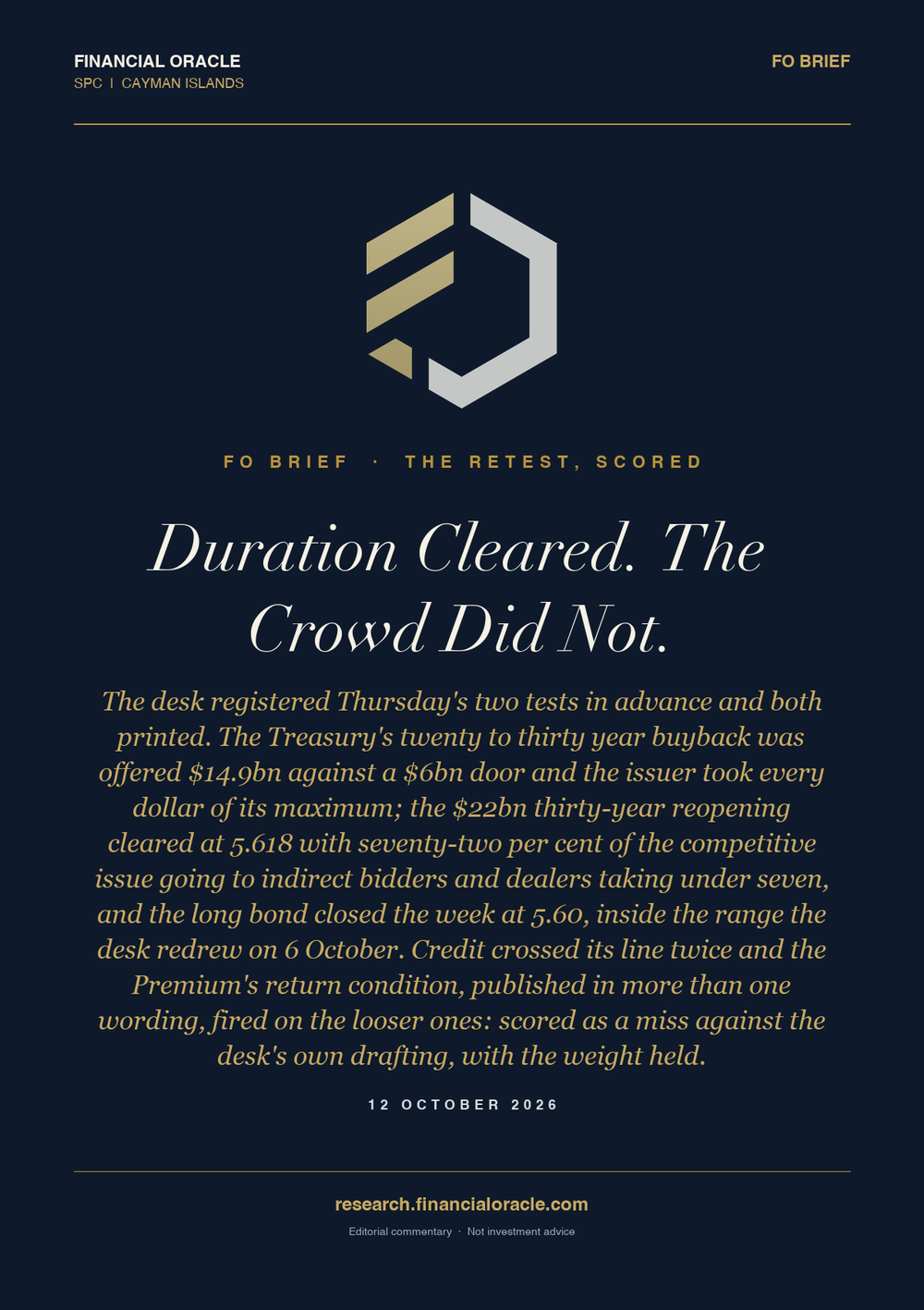
Every FO Brief and Analysis Report opens on the site for everyone, with the setup, the dated hook and a full contents list of what the note carries. The remainder, with the scenario maps, the invalidation criteria, the tactical reads and the PDF, is for Premium. Free members also receive each note’s teaser by email as it ships.
How are reports delivered?
By email the moment a report publishes, with the full archive accessible on the site. Premium receives every report in full, plus archive grade PDF downloads; free members receive each note’s teaser and contents. We don’t drip-feed; the report arrives when it ships.
Can I reply to the desk?
Yes. Premium subscribers can reply directly to any FO Research email: replies route to the desk and are read. For research correspondence outside of an active subscription, email research@financialoracle.com. For investor relations with Financial Oracle SPC, partner@financialoracle.com.
Can I cancel?
Any time, from the member portal. No retention friction. Cancellations take effect at the end of the cycle, and you keep access until the end of the period you have paid for.
How is Institutional access granted?
By application. Institutional is reserved for qualified subscribers: allocators, family offices and institutional desks. Apply at /apply/, or enquire at partner@financialoracle.com.
What kind of reader is this for?
Allocators using a structured second opinion. Practitioners anchoring their macro framework. Institutional desks shortening the time between an event and a defensible internal narrative. Not designed for retail pattern-trading audiences.
How often does the desk publish?
Multiple publications a week, event-driven rather than calendar-bound. See the pricing page for the full comparison.