FO Research / Inflation
Inflation
research.
All FO Research reports filed under Inflation.
29 reports filed under Inflation
 FO Analysis: The Ratchet.
Crude round-tripped ten dollars in four sessions and the odds of a rate rise gave back only a fraction of their tripling.
 Gold vs Real Yields: Why They Move Together (and When They Don't)
 The Shock Round-Trips. The Floor Doesn't.
Inside four sessions crude spiked to a new leg high on the war and gave nearly all of it back when the weekend brought a pause in the strikes and revived hopes of talks. Brent touched 100 and retreated toward 90. The long end of the curve moved five basis points up and four back and never left the top of its band, and rate-rise bets rose on the spike and kept most of the move through the fade. A floor that absorbs the shock in both directions is not riding the shock. It is structural. The Fed decides Wednesday.
 FO Analysis: The Crack Premium.
The shorthand: crude is the price on the screen, products are the price the economy pays, and the gap between them set a record on 16 July before rolling over this week. That gap is the transmission, it reaches the consumer with a lag of one to three weeks, and it lands in the August inflation print rather than the July one.
 The Disinflation Arrives. The Floor Doesn't Break.
June CPI came in soft across the board: headline at 3.5% against a 3.8% consensus, core down to 2.6%, and prices falling outright on the month, every line below consensus. The disinflation the market waited for arrived, and Treasuries rallied on it. But the rally stopped at the front, where a July rate rise came off the table; the thirty-year refused to follow and closed at the top of its band. A bull steepener, not a broken floor. The floor bent. It did not break.
 FO Analysis: The Synchronised Floor.
The shorthand: the long end holds its band while the Fed and the ECB turn hawkish in the same week and the pipeline stays firm beneath them, and only the Bank of Japan still holds. The floor under long rates is no longer a US idiosyncrasy. It is a synchronised, cross-central-bank regime, and the yen is where the one holdout's divergence is being paid.
 The Pipeline Translated.
May PCE printed a four-handle headline and the hottest core since 2023. The Fed's own preferred gauge has now confirmed what the desk called in May: this is a services-led pipeline, not an energy spike, and it pins the Fed against the floor. The cut case is gone.
 Both Sides. One Tell.
On the same day, the US pipeline ran hot beyond energy and the ECB hiked for the first time since 2023, justifying it on a broadening of price rises. The euro was sold on the hike. The 30-year held its third test in a week. Inflation is spreading past the oil story on both sides of the Atlantic, and the dollar is the relative winner.
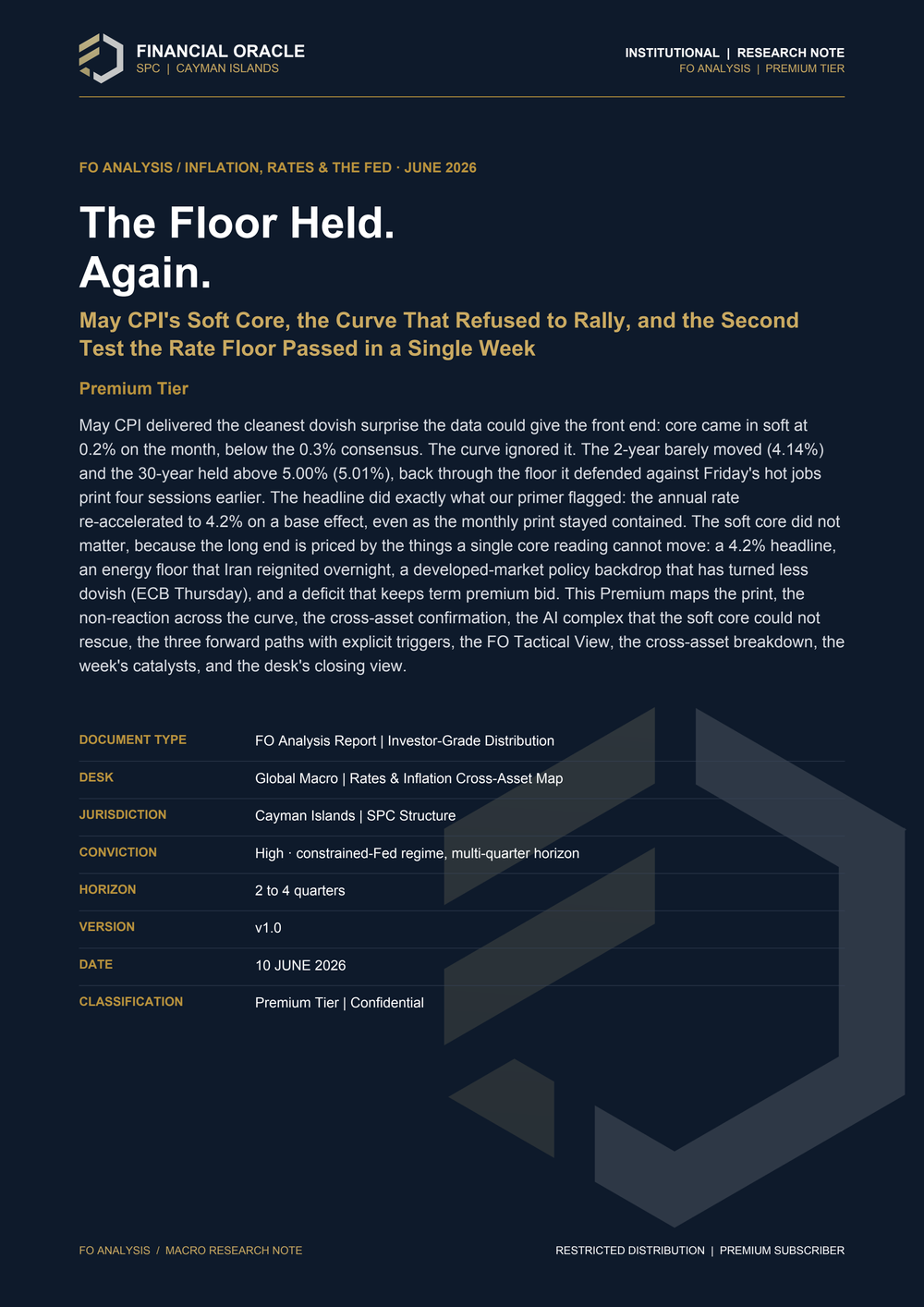 FO Analysis: The Floor Held. Again.
The shorthand: core m/m 0.2% (soft, vs 0.3% consensus), headline y/y 4.2% (the base-effect re-acceleration, dead on), the 2-year unchanged at 4.14%, the 30-year holding 5.01% above the floor, gold off 2.4% on higher real yields, the dollar firm, the VIX higher, and an AI complex that was already selling into the print and that a dovish core could not rescue. A soft core is necessary for a dovish turn. It is nowhere near sufficient.
 The Floor Meets the Print
Tomorrow's May CPI is the second test of the rate floor in a week. The monthly number is set to cool while the annual rate re-accelerates, and that split is the trap. Here are the three paths the print can take, the levels that decide which one lands, and why the 30-year may hold above 5.00% either way.
 FO Analysis: Six Pillars. One Regime.
The shorthand: April core PCE 3.3% on the year, the 30-year sitting on 5%, the front end pricing relief the long end will not ratify, Brent back through 93, USD/JPY 159, semis a record share of the S&P, and credit spreads 272bp tight. Six pillars active, one regime.
 The Warsh Inheritance
The gap between what the market is pricing and what the incoming chair has spent two decades signalling is wider than at any Fed transition since 2006. That gap always closes. The path the closing takes — through communication on 17 June or through a 2-year repricing in the meantime — is the next quarter’s trade.