Regime
The Barrel Fell. The Core Did Not.
The five things that matter
1. Inflation did not follow oil down. October CPI rose 0.4 per cent on the month against 0.3 expected, and core CPI, which leaves out food and energy, rose 0.3 per cent against 0.2 expected (BLS, 10 November 2026, 13:30 GMT, 17:30 Dubai). It is the third consecutive core reading at about 0.3: annualised over three months core is running at 3.75 per cent, against 2.7 per cent over six. Services excluding housing rents, the part of inflation most tied to wages, rose 0.45 per cent, its fastest since May. The energy index rose only 0.7 per cent. This was not an oil print.
2. The case for a December rise has strengthened. Governor Waller said on Tuesday morning, setting out his own view rather than the committee's, that a half-point rise could be warranted in December if October core came in around 0.3 per cent or higher, and that at a minimum the Fed should take back its three insurance cuts (newswires, 10 November 2026). Unrounded, core printed 0.296. The two-year Treasury yield, the maturity most sensitive to the Fed, settled at 4.73 on Tuesday, up seventeen basis points on the day (US Treasury). Dallas Fed President Logan went further that afternoon: policy is at least half a point short of modestly restrictive, so at least two more quarter-point rises are needed, possibly more rapidly this winter (newswires, 10 November 2026). Prediction market pricing puts a December rise at about 95 per cent and a further rise in January at about 48 per cent. A quarter-point is the desk's base case; after Waller's and Logan's remarks a half-point is a credible risk, not a decision the committee has made.
3. Oil has stopped being the problem it was in October. The January Brent contract trades at 92.37, from 104.36 on 3 November, on reports of US and Iranian mediation that remain unconfirmed and are partly denied; it traded at 89.37 on Tuesday afternoon and recovered as vessels were attacked near the strait (desk feed, 03:25 GMT, 07:25 Dubai; newswires, 9 to 11 November 2026). The ten-year breakeven, the bond market's inflation compensation, which also carries risk and liquidity premiums, settled at 2.20 on Tuesday, below its 5 August low of 2.22. The energy-shock path the desk carried at a fifth of its map is losing its evidence, though not its risk.
4. The thirty-year broke the desk's range, and the range is redrawn. The 6 October Premium drew the thirty-year yield's range at 5.30 to 5.80. It closed through the floor on 22 October and again on 2 November, and settled below 5.30 on five of the six sessions to Monday, at 5.26. The desk scores the range missed and retires it here. On Tuesday, after the CPI and a soft ten-year auction, it settled at 5.35, back above the old floor and inside the redrawn range. The term premium, the extra yield investors demand for holding long bonds, fell from 1.10 on 5 October to 0.87 on 6 November, the latest estimate, so the main claim behind the range did not hold either.
5. Credit is close to the line that would change the desk's mind, but has not crossed it. High-yield spreads, the extra yield investors demand to lend to riskier companies, reached 3.48 on 5 November, two basis points short of the 3.50 the desk said would make the growth scare its base case, on the day the S&P 500 fell 4.4 per cent (ICE BofA via FRED; S&P via FRED, 5 November 2026). They printed 3.42 on Friday and eased to 3.34 on Monday. The credit route needs four consecutive settles above 3.50, and none has printed.
The desk's conclusion. The inflation problem has moved from the barrel to the core, and the committee is about to respond to it. The desk retires the October map of 45, 35 and 20 and draws a new one to the December meetings: 50 on the committee catching up, 35 on the tightening biting into credit and growth, and 15 on the energy shock returning. The thirty-year range is redrawn at 5.10 to 5.50, with 5.30 as the pivot; the 4.85 line that would falsify the floor thesis is unchanged. Five of the desk's own published descriptions are scored missed at full weight; the thirty-year range breached on two closes and is scored as one miss. None of this is trade or investment advice; the desk cannot give it, and every trading decision is the reader's own.
What changed since the last Premium
The last Premium, The Price of Duration, was written on the 5 October settles. Since then the long end has rallied, the front end has rallied less, and inflation compensation has fallen with oil while the policy path has firmed.
| 5 Oct settle | 10 Nov settle | Live, 03:25 GMT 11 Nov | Change, 5 Oct to 10 Nov | |
|---|---|---|---|---|
| Two-year Treasury yield, % | 4.84 | 4.73 | n/a | minus 11bp |
| Ten-year Treasury yield, % | 5.31 | 4.98 | n/a | minus 33bp |
| Thirty-year Treasury yield, % | 5.66 | 5.35 | n/a | minus 31bp |
| Ten-year real yield, % | 2.95 | 2.66 (9 Nov) | n/a | minus 29bp |
| Ten-year breakeven, % | 2.36 | 2.20 | n/a | minus 16bp |
| Ten-year term premium, % | 1.10 | 0.87 (6 Nov) | n/a | minus 22bp |
| High-yield spread, % | 3.12 | 3.34 (9 Nov) | n/a | plus 22bp |
| Brent, front contract, $ | 100.32 (Dec) | 92.05 (Jan) | 92.37 (Jan) | contract roll inside |
| Gold, $ | 4,141 | 4,033 | 4,048 | minus 2.6 per cent |
| Dollar index | 102.10 | 102.15 | 102.14 | flat |
Sources: US Treasury daily par yield curve; FRED (TIPS real yield, breakeven, New York Fed ACM term premium estimate, ICE BofA high-yield spread); desk feed, daily closes and quotes at 03:25 GMT, 07:25 Dubai, on 11 November; Brent on the front exchange contract, December 2026 to its 30 October expiry and January 2027 after it. Treasury yields are official settles; no live yield is used in this snapshot. A basis point (bp) is one hundredth of a percentage point.
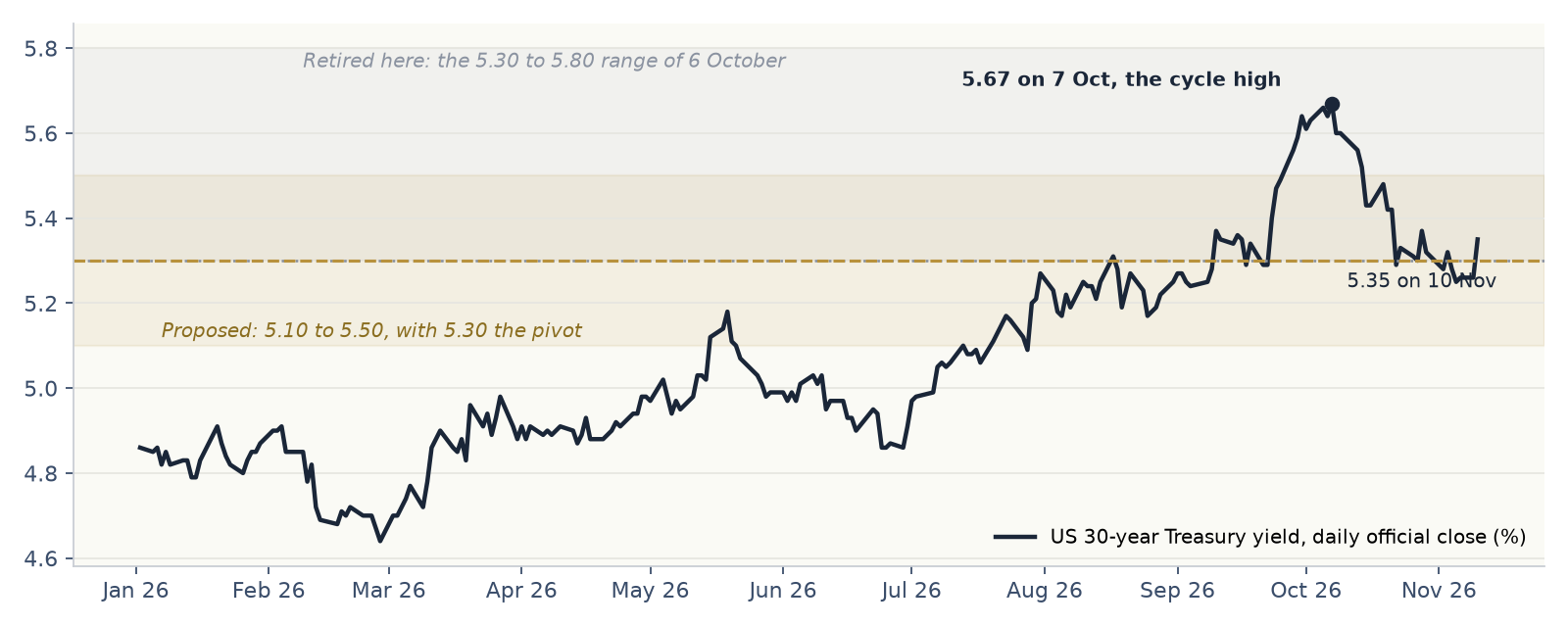
The thirty-year made its cycle high of 5.67 on 7 October, two sessions after the last Premium, and was forty-one basis points lower at Monday's close. It closed below the 5.30 floor on 22 October and on five of the six sessions from 2 November, then settled at 5.35 on Tuesday. The grey band is the retired 5.30 to 5.80 range; the gold band is the proposed 5.10 to 5.50, with the old floor kept as the pivot. Source: US Treasury daily par yield curve, official closes through 10 November 2026.
The desk published the tests in advance. Here is how they scored.
Twelve published calls were tested: 4 held, 1 partial, 2 conditions did not fire, 5 missed. The marks are the 10 November settles unless stated. The five misses, each at full weight, are the thirty-year range of 5.30 to 5.80, the term premium above one point, the two-year band of 4.65 to 4.95, the breakeven band of 2.25 to 2.45, and the 30 October reading that the equity sell-off was not a credit event. The thirty-year range breached on two closes and is scored as one miss.
The Record's published mark is 9 October, revised 29 October: 80 scored calls, 79 per cent held or better, 14 missed. These rows enter it at its next mark. Inspect the record, misses included: research.financialoracle.com/calls.
| Continue Reading / FO Premium |
| The rest of this note is for Premium subscribers. |
| You have read the conclusions, what changed and the scorecard summary of The Barrel Fell. The Core Did Not. The analysis continues with the reasoning, the full scenario map and what each path means for every major market. |
| ✓Where does the desk stand now, and what would move it? The regime dashboard at a glance, then three paths to the December meetings, each with its weight, its trigger and the level that invalidates it. |
| ✓How hot was October, really? What the 0.296 core print, the services detail and the missing twelve-month figure tell the committee. |
| ✓Will the Fed raise by a quarter or a half on 9 December, and what is already priced? |
| ✓Why did the long end fall through the desk's floor, and why does the desk keep the floor thesis? |
| ✓Is credit about to crack? The 3.50 line, the equity sell-off and what would convert the growth path. |
| ✓Is the oil shock over? The January contract, the mediation reports and the conditions that would bring the shock back. |
| ✓What it means for the dollar index and seven major pairs, with speculative positioning compared side by side, plus rates, credit, oil, gold and equities, path by path. |
| ✓Where the clearest signals are: which market relationships carry the view, which are crowded and which still need confirmation. |
| ✓The five signals that matter next, ranked, then the dated calendar in GMT with Dubai to the 18 December meetings. |
| ✓The desk-formatted Premium PDF, for print and offline reading. |
| Recently Published |
| 30 October 2026The Committee Held. The Long End Did Not.The committee held 10 to 2, with two votes for a rise and no December guidance, and a day later the two-year settled through 4.65. |
| 16 October 2026Warsh Won't Signal. The Data Will.The Chair declined to signal before the blackout. With CPI at 3.7 per cent, the data now carries the next twelve days. |
| 15 October 2026The Print Was Hot. The Tape Sold It.September CPI printed 0.6 and 3.7, core 0.3 and 2.6, and the dollar made an eighteen-month high. |
| Every published desk call is dated before the print and scored after it, misses included. Inspect the record before you pay for it |
| Subscribe to FO Premium |
| Editorial-grade macro research, written for sophisticated readers. Notes land when the data warrants. New to the mechanics? The Learn section is open to everyone. |
The research is Premium. The record is public.
Every Brief and Analysis in full: the analysis and market implications, the conditions that would change the desk’s view, the scenario maps, the tactical reads and the PDFs; the scorecard stays public. Inspect the record before you pay for it.
Subscribe to PremiumNot ready? Get the free read by email. New to the mechanics? Learn is open to everyone.